Editorial: The Leadership Crisis of Santa Ana Mayor Valerie Amezcua Endangers Residents

In a city recognized for its dedication to immigrant populations, Mayor Valerie Amezcua of Santa Ana is at the heart of a rising controversy that casts doubt on her leadership and the priorities she holds. At the City Council meeting on May 6th, 2025, the remarks made by Mayor Amezcua indicated a disturbing shift in attention—one that seems more focused on securing federal funds and political authority rather than safeguarding the very individuals she was elected to represent.

Santa Ana has been esteemed as a sanctuary city for many years, a stance based on the principle that all residents—irrespective of their immigration status—are entitled to public services, safety, and respect. This dedication has turned the city into a haven for many, particularly during uncertain times surrounding immigration laws. However, recent comments from Mayor Amezcua imply that this core value is now at risk—not from outside influences, but from officials within City Hall.

During the tense council meeting on May 6th, Amezcua expressed worries about the possible loss of federal financing linked to law enforcement activities, emphasizing how it could affect police resources and her own position. While financial management is crucial, framing the conversation in such self-focused terms has unsettled the community. It has conveyed to many that the mayor may be contemplating compromising the city’s sanctuary policy—not out of necessity, but from apprehension—fear of losing authority, funding, and ultimately, control.

This type of leadership—or the lack thereof—is genuinely concerning. Sanctuary policies represent more than mere symbols; they function as critical protections. By discouraging collaboration with Immigration and Customs Enforcement (ICE), these policies help undocumented individuals feel secure when reporting crimes, accessing emergency aid, and engaging in community affairs. Dismantling those protections would lead to immediate and severe repercussions, especially for the most vulnerable segments of our society.

The mayor’s seemingly open approach to modifying the city’s sanctuary policy without a defined strategy or community agreement erodes trust in local governance. Citizens should have leaders who uphold principles amidst political challenges, not ones who falter when facing financial difficulties or partisan pressures.

Additionally, the timing and manner of Amezcua’s comments were highly inappropriate. In a year characterized by escalating anti-immigrant feelings across the country, Santa Ana should be strengthening—not stepping back from—its standing as an example of inclusive governance. Instead, the mayor’s statements have created confusion, fear, and division at a time when solidarity is urgently needed.

We urge Mayor Amezcua to clarify her stance publicly and clearly reaffirm her dedication to Santa Ana’s sanctuary values. If she is unable to do so sincerely, perhaps it is time for new leadership to emerge—leadership that embodies the principles of compassion, bravery, and community that Santa Ana truly deserves.

Let’s keep in mind the purpose of sanctuary cities: they are meant to preserve lives, not to challenge federal power. The mayor should be aware that her responsibilities involve ensuring the safety of individuals, rather than just obtaining financial support. At this moment, the residents of Santa Ana are closely observing her decisions and the direction she takes.


Editorial: The Broken Promise of Sanctuary: ICE Raids in Santa Ana Expose Leadership Failures


In recent weeks, the city of Santa Ana, California—self-identified as a sanctuary for undocumented immigrants—has been thrust into national attention following a series of aggressive Immigration and Customs Enforcement (ICE) raids that have left its predominantly Latino community in distress. These operations serve as a stark reminder of how tenuous the notion of “sanctuary” is when local leadership fails to uphold its commitments. At the core of this controversy is Mayor Valerie Amezcua, whose tenure has increasingly come under scrutiny as her administration seems ill-equipped—or perhaps unwilling—to protect residents from federal encroachment.


Santa Ana, similar to many cities throughout the United States, adopted sanctuary policies with the aim of fostering trust between immigrant communities and law enforcement. The premise was straightforward yet powerful: local police would not cooperate with federal immigration authorities unless absolutely necessary, ensuring that all residents could feel secure in reporting crimes or seeking assistance without the dread of deportation. For years, these measures have acted as a lifeline for thousands of families who consider Santa Ana their home. However, now faced with an intensifying crackdown by ICE, the facade of protection offered by these policies appears to be fraying—and one cannot help but question whether Mayor Amezcua holds some responsibility for the turmoil unfolding before us.

A Crisis Unfolding

The recent surge of ICE arrests in Santa Ana has sent shockwaves through neighborhoods already contending with economic difficulties and systemic inequality. Families have been shattered, children left without parents, and businesses disrupted as workers disappear overnight. Community leaders report widespread anxiety among residents, who are now uncertain about where they can turn for safety. This climate of fear is precisely what sanctuary policies were intended to avert—but instead, it appears the city’s leaders have permitted ICE agents to disrupt lives with impunity.


What renders this situation particularly outrageous is the fact that Santa Ana’s population is predominantly Latino, with nearly three-quarters of its residents identifying as Hispanic or Latinx. Many of these individuals arrived in the United States in search of improved opportunities for themselves and their families, contributing significantly to the cultural and economic fabric of the city. Yet rather than standing firmly with them during this crisis, Mayor Amezcua has seemed absent at best—and complicit at worst.

Leadership on Trial

Since assuming office, Mayor Amezcua has faced challenges in exhibiting effective leadership, often criticized for favoring optics over substantive action. Her response to the current ICE raids has done little to alleviate those apprehensions. While other mayors of sanctuary cities have publicly denounced such actions and worked diligently to protect their constituents, Amezcua has conspicuously maintained her silence. When pressed for clarification, she provides vague assurances about “working within legal frameworks” but refrains from committing to tangible measures that might genuinely protect vulnerable residents.
This absence of decisive action prompts significant inquiries regarding her dedication to the very constituents she vowed to serve. How can a mayor assert her representation of a community when she declines to confront forces that threaten its very survival? In moments of crisis, authentic leadership necessitates boldness—not timidity. It mandates heeding the voices of those most impacted and undertaking substantive measures to fulfill their needs. Regrettably, Mayor Amezcua’s history implies she possesses neither the courage nor the vision to meet the chall

A Call to Action

The struggles of Santa Ana’s immigrant community should act as a clarion call, not only for Mayor Amezcua but also for every elected official in municipalities across the nation. Sanctuary policies are of no consequence if they cannot be enforced effectively—and such enforcement commences with robust, principled leadership ready to oppose injustice. Local administrations must investigate every potential avenue to resist federal overreach, ranging from legal disputes to grassroots initiatives aimed at empowering marginalized populations.

Furthermore, residents are urged to hold their leaders accountable. If Mayor Amezcua is unable to fulfill the promise of sanctuary, then it may be time for another individual to rise to the occasion—someone who comprehends the stakes involved and possesses the moral clarity required to uphold human dignity above all else.

Conclusion

Santa Ana stands at a pivotal juncture, torn between the ideals it previously embraced and the harsh realities of existence under an increasingly antagonistic federal administration. For an extended period, the city’s leaders have depended on vacuous rhetoric while neglecting to enforce meaningful protections for their most vulnerable residents. As ICE persistently targets Latino families in Santa Ana, one irrefutable truth emerges: the era of empty gestures has concluded. Genuine transformation will necessitate authentic leadership—and until Mayor Amezcua demonstrates her ability to provide such leadership, the residents of Santa Ana merit superior representation.

La alcaldesa de Santa Ana, Valerie Amezcua, podría colaborar con el Servicio de Inmigración y Control de Aduanas (ICE) en la implementación de estas directivas federales

Foto de: Igmar Rodas / The Orange County Reporter

En los últimos días, Santa Ana, una ciudad ubicada en el condado de Orange, California, ha vivido extensas protestas pacíficas. Estas manifestaciones han sido impulsadas principalmente por la gran comunidad latina de la ciudad, que ha expresado una gran preocupación por múltiples cuestiones interconectadas.

Un tema clave en juego son las recientes políticas migratorias del presidente Donald Trump, especialmente sus propuestas de deportaciones masivas de inmigrantes indocumentados, incluidos aquellos sin antecedentes penales que se desempeñan como miembros diligentes y contribuyentes de la sociedad. El plan del gobierno de invocar la Ley de Enemigos Extranjeros de 1798 para acelerar las deportaciones ha intensificado estas preocupaciones.

Foto de: Igmar Rodas / The Orange County Reporter

Para agravar aún más el malestar local, hay informes que indican que la alcaldesa de Santa Ana, Valerie Amezcua, podría estar coordinando con el Servicio de Inmigración y Control de Aduanas (ICE) para ejecutar estas órdenes federales. Muchos perciben esta supuesta colaboración como una violación de la ley de ciudades santuario de Santa Ana de 2017, que se promulgó para proteger a las personas indocumentadas de las acciones federales de inmigración.

Las protestas se han caracterizado por su enfoque no violento, con manifestantes que abogan por la protección de los derechos de los inmigrantes y el cumplimiento de la ordenanza de ciudad santuario. Los líderes comunitarios y los defensores están promoviendo políticas que reconocen el papel de los inmigrantes indocumentados y buscan una reforma migratoria integral en lugar de acciones punitivas.

Foto de: Igmar Rodas / The Orange County Reporter

Estos sucesos en Santa Ana reflejan una conversación nacional más amplia sobre las políticas de inmigración y la participación de los gobiernos locales en su aplicación. A medida que la situación evoluciona, pone de relieve la discordia entre los mandatos federales y los principios comunitarios, en particular en áreas con grandes poblaciones de inmigrantes.

Santa Ana Mayor Valerie Amezcua may be collaborating with Immigration and Customs Enforcement (ICE) in the implementation of these federal directives

Photo by: Igmar Rodas / The Orange County Reporter

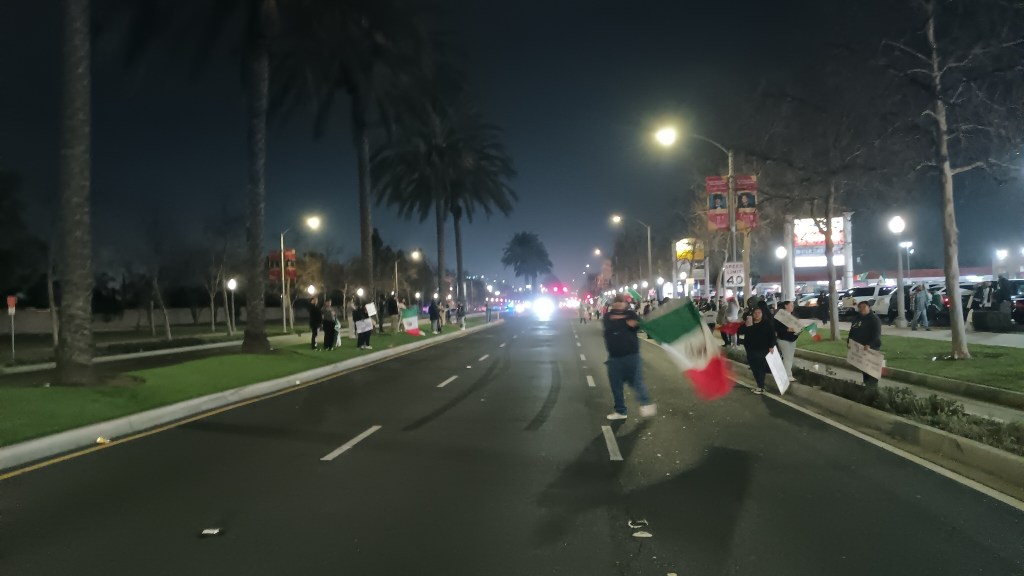
In recent days, Santa Ana, a city located in Orange County, California, has experienced extensive peaceful protests. These demonstrations have been mainly fueled by the city’s large Latino community, voicing significant concern over multiple interconnected issues.


A key issue at stake is President Donald Trump’s recent immigration policies, especially his proposals for mass deportations of undocumented immigrants, including those without criminal histories who serve as diligent, tax-paying members of society. The administration’s plan to invoke the 1798 Alien Enemies Act to accelerate deportations has intensified these worries.

Photo by: Igmar Rodas / The Orange County Reporter


Further aggravating local unrest are reports indicating that Santa Ana Mayor Valerie Amezcua may be coordinating with Immigration and Customs Enforcement (ICE) to carry out these federal orders. Many perceive this alleged collaboration as a breach of Santa Ana’s 2017 sanctuary city law, which was enacted to safeguard undocumented individuals from federal immigration actions.


The protests have been characterized by their non-violent approach, with demonstrators advocating for the safeguarding of immigrant rights and compliance with the sanctuary city ordinance. Community leaders and advocates are promoting policies that acknowledge the roles of undocumented immigrants and pursue comprehensive immigration reform rather than punitive actions.

Photo by: Igmar Rodas / The Orange County Reporter


These occurrences in Santa Ana mirror a wider national conversation regarding immigration policies and the involvement of local governments in enforcing them. As the situation evolves, it highlights the discord between federal mandates and community principles, particularly in areas with large immigrant populations.