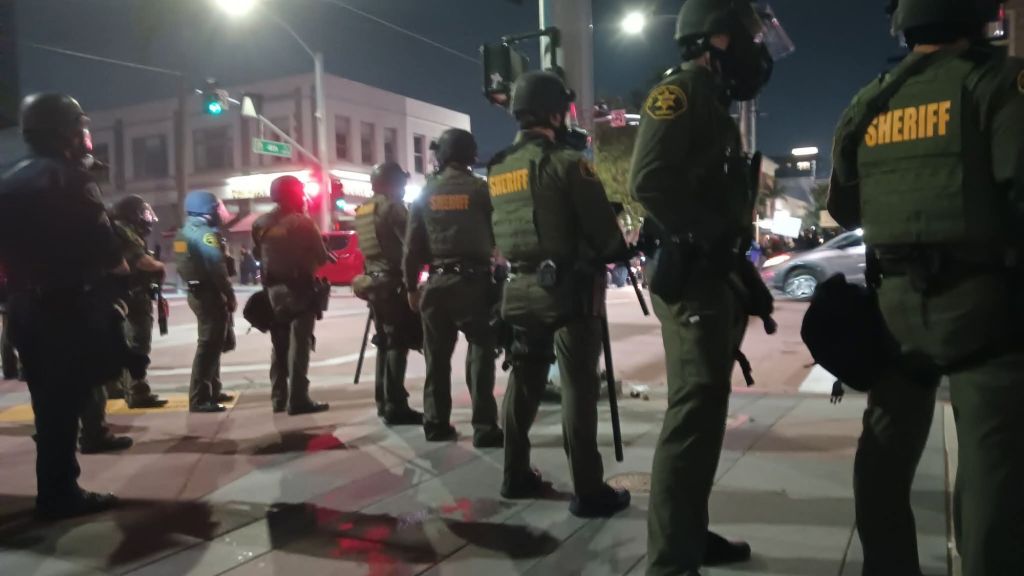
What started out as a calm protest in Downtown Santa Ana quickly descended into disorder and violence as various law enforcement agencies —including the Santa Ana Police Department, Huntington Beach, Anaheim, Irvine, Seal Beach, La Palma, Orange County Sheriff’s Department (OCSD), even the California National Guard— descended on the demonstration to forcefully disperse the crowd.
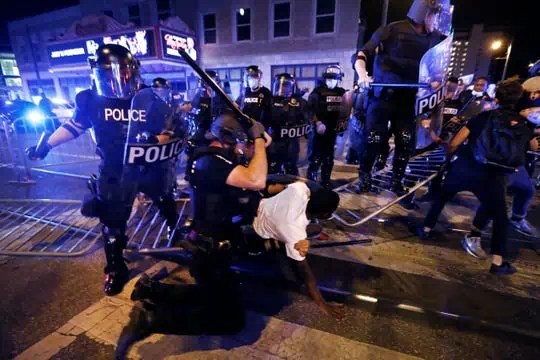
Witnesses say that police in riot gear advanced fiercely aided by armored vehicles and monitoring drones. What should’ve First Amendment rights exercise turned into a conflict involving tear gas, rubber bullets, and batons against demonstrators. Police sirens and shouting dispersal commands drowned out justice chants.
Orange County Sheriff Department
Why agencies from cities miles away—including Huntington Beach and Seal Beach—were called in to intervene in a Santa Ana protest? Why was the National Guard sent in a civilian environment and with what mandate?
The scene reflected a disturbing national trend: the swift militarization of local law enforcement and the organized suppression of public opposition. It begs immediate concerns about civil liberties, jurisdictional overreach, and the decline of local trust when peaceful protesters are treated as enemy combatant and police from different jurisdictions act in harmony without transparency or local accountability.
Santa Ana Police Department
This is not public safety.” This is a display of power;it sets a hazardous precedent.”
City and county level elected officials have to account for this increase. Mayor Valerie Amezcua and the Santa Ana City Council have to account for their involvement—or lack of influence—regarding what happened. People ought to know why if they approved this.Who else would?
Demonstrators put up a barrier
The citizens of Santa Ana are entitled to object, seek justice, and hold those in authority responsible. Official news releases or cleaned reports should not cover the events of this day. The community is watching; history will remember.
Recent occurrences throughout the United States have once more illuminated the concerning dynamics among law enforcement, politics, and the justice system. The most recent tragedy—the shooting and killing of a man by the Anaheim Police Department—represents yet another chapter in a burgeoning narrative of police violence that appears to be unrestrained. This incident is not an isolated event, but rather a manifestation of a much deeper, systemic issue, wherein police officers, safeguarded by politicians, continue to evade meaningful accountability for their actions.
The demise of Tamir Rice, a 12-year-old boy fatally shot by police in Cleveland in 2014, stands as a stark reminder of how swiftly law enforcement can resort to lethal force without repercussions. Rice’s heartbreaking death served as a catalyst for protests nationwide; nevertheless, years later, episodes like the one in Anaheim indicate that little has altered. The question then arises: why are these officers still unpunished?
A pervasive culture of impunity exists within police departments, one that is sustained by political figures who depend on these law enforcement entities for support and empowerment. Police unions, with their considerable political influence, have frequently protected officers from accountability, even when they have contravened the most fundamental principles of justice. The deeply rooted connections between law enforcement and politicians often imply that the very individuals who ought to uphold the law are accorded an unfair advantage concerning evading punishment.
However, the issue transcends the officers themselves. The very foundation of our justice system—judges—also plays a pivotal role in perpetuating this cycle. Time and again, judges have neglected to hold law enforcement accountable, extending leniency or outright dismissing charges against officers implicated in fatal shootings. While the public focuses on the officers who discharge their firearms, the judiciary that consistently exonerates them of misconduct should not be overlooked. It is insufficient to merely demand justice for the victims of police violence; we must also confront the broader system of corruption that guarantees these actions go unpunished.
There are calls to cease referring to law enforcement officers as “officers”—a gesture intended to remove the deference with which they are frequently regarded, to remind us that they are public servants, not untouchable entities. This rebranding is symbolic yet necessary. The public’s perception of law enforcement often elevates them to a status that obscures their role as accountable servants of the law. We must acknowledge them as individuals capable of wrongdoing, just like anyone else—and ensure they are held to the same standards.
Moreover, the citizens of this nation must reclaim their rights and commence utilizing their constitutional amendments to contest and resist these systemic abuses of power. It is essential to demand transparency, to insist on independent investigations, and to hold accountable not merely the officers who engage in these actions, but also the politicians, unions, and judges who shield them. The strength of the populace resides not solely in protests and appeals for justice but in the active participation with the mechanisms of power that facilitate these abuses.
Finally, we must hold our political leaders, such as Congressman Lou Correa, responsible for their involvement in sustaining this system. When politicians protect and advocate for law enforcement at the cost of justice, they foster a culture of corruption. They are complicit in the preservation of a system that injures marginalized communities and disregards fundamental human rights.
In conclusion, the epidemic of police violence cannot be addressed by focusing on individual officers alone. It necessitates a comprehensive strategy that includes holding not only law enforcement accountable but also the political and judicial systems that allow this violence to persist. We must demand a total reform of the systems that protect and sustain this cycle of impunity. Only then can we aspire to cultivate a society where justice genuinely signifies justice for all.




 The OC Reporter