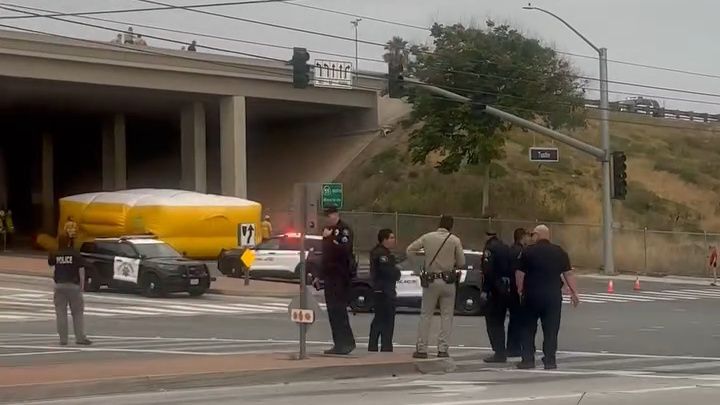
Una mujer de 19 años fue detenida en Orange después de un enfrentamiento en un paso elevado de la autopista.

ORANGE, California—28 de mayo de 2025

Tras una amenaza de saltar desde un paso elevado de la autopista Orange el miércoles por la noche, una mujer de 19 años fue detenida. Esto provocó el cierre de varios carriles en la autopista Costa Mesa (55).

Las autoridades informaron que el incidente ocurrió poco antes de las 4:30 p. m. cerca del paso elevado de la avenida Lincoln. Alrededor de las 4:25 p. m., agentes de la Patrulla de Carreteras de California (CHP) comenzaron a desviar el tráfico de la zona mientras las autoridades intentaban resolver el asunto.

El teniente Phil McMullin, del Departamento de Policía de Orange, confirmó que la joven parecía estar en estado de angustia emocional y que había ascendido a la cornisa del paso elevado, lo que aumentaba la preocupación por su seguridad.

Un negociador de crisis del Departamento de Policía de Orange se unió al equipo de respuesta y habló con la mujer durante más de una hora para intentar ponerla a salvo. Las autoridades informaron que fue arrestada discretamente poco antes de las 6 p. m.

“Ella cooperó una vez que pudimos establecer comunicación”, dijo el teniente McMullin, y agregó: “Nuestra prioridad siempre fue su bienestar”.

Trasladada a un hospital cercano para realizarle pruebas, se espera que la mujer reciba tratamiento y apoyo a través de los servicios de salud mental del condado.

Debido a la ubicación del enfrentamiento, la autopista 55 estuvo cerrada en ambas direcciones durante varias horas, lo que provocó una grave congestión vehicular en las horas punta de la tarde. La Patrulla de Caminos de California (CHP) reabrió la autopista poco después de las 7 p. m.

Este suceso pone de relieve la importancia de la concienciación sobre la salud mental y el papel fundamental de los equipos de respuesta a crisis capacitados en situaciones difíciles.

Cualquier persona que tenga información o haya presenciado los sucesos previos al enfrentamiento debe comunicarse con el Departamento de Policía de Orange.

Anuncio de Servicio Público:

“Si usted o alguien que conoce se siente abrumado o piensa en suicidarse, por favor, contáctenos”.

“Hay personas que se preocupan y recursos que pueden ayudar”.

La Línea de Apoyo entre Pares de California está disponible las 24 horas, los 7 días de la semana, al 1-855-600-9276 para cualquier persona que experimente angustia emocional.

También puede contactar a esta agencia por teléfono celular.

Hay ayuda disponible.

Hable con alguien hoy mismo.

988 Línea de Ayuda para Suicidios y Crisis
Idiomas: Inglés, Español
Horario: Disponible las 24 horas

Llame al: 988
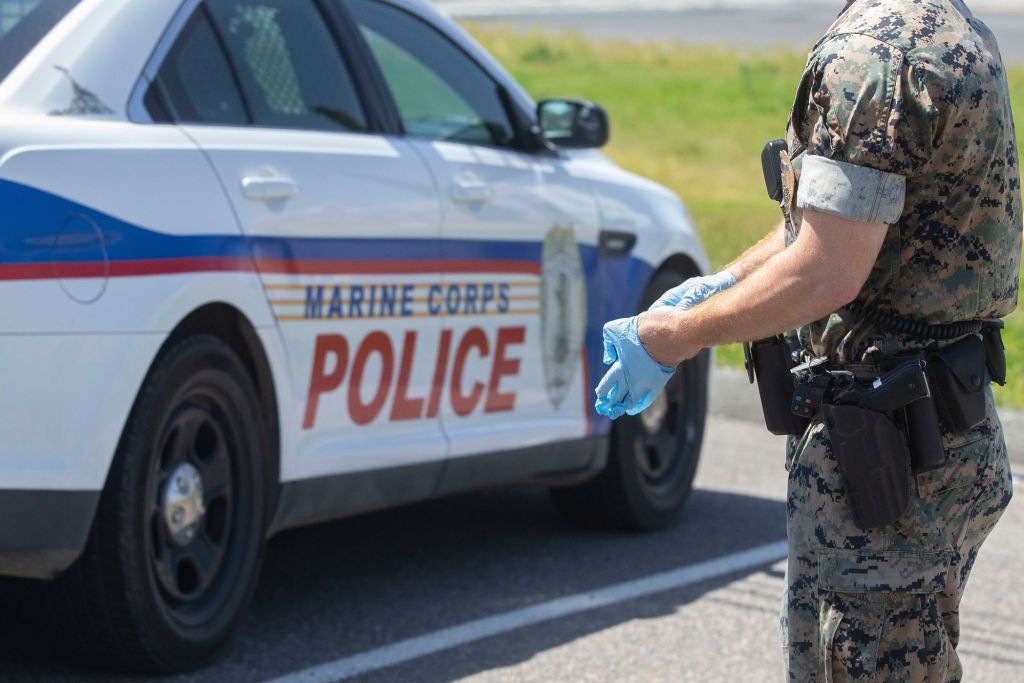
Editorial: A Personal Encounter Underscores the Significance of Clear Boundaries at Camp Pendleton

US Military Base Camp Pendleton MP

I unintentionally entered Camp Pendleton this week through one of its public access sites, which put me in an unexpected situation. I had accidentally driven onto federal property, which was a genuine mistake that was immediately noticed by the military police at Camp Pendleton.

After that, I had a courteous and professional conversation with the MPs who pulled me over at the entrance checkpoint. They checked my identification, interrogated me about why I was there, and made sure I wasn’t a security risk. They gave me a warning and sent me back to the main road after concluding that my presence was unintentional and not dangerous.

The U.S. Immigration and Customs Enforcement (ICE) agency was noticeably absent from this interaction. I was not surprised by this fact given that immigration enforcement and law enforcement frequently converge in unexpected ways in the current environment. And the fact that the military police were entirely concerned with security and safety—not immigration status—gave me a sense of comfort.

Every U.S. military facility, including Camp Pendleton, has its own distinct jurisdiction. It is a community that welcomes thousands of service members, their families, and civilian workers, as well as a sovereign military area. The military police’s decision not to include ICE during regular vehicle stops or searches is not only legally correct but also necessary for preserving trust and operational efficiency inside the base.

Camp Pendleton

The lack of immigration enforcement in routine policing creates a culture of security and cooperation for people who reside or work on base, such as civilian contractors, international military liaisons, or foreign nationals serving under special visas. It makes certain that individuals are not deterred by the threat of deportation from seeking necessary services or reporting crimes.

My brief but ultimately uneventful experience serves to emphasize a more fundamental point: military facilities must continue to prioritize their primary purpose of protecting the country. The law enforcement in that area should be carried out with professionalism, clarity, and a thorough awareness of the unique characteristics of military communities.

For a long time, the Department of Defense has maintained that military facilities are not the place for local law enforcement activities that have nothing to do with base security. Whether by duty, invitation, or, like in my case, by mistake, this policy safeguards the integrity of the military objective as well as the rights and dignity of all persons who enter the base.

The Camp Pendleton Military Police should be praised for their professional and cautious response to the situation. Their behavior demonstrates a dedication to the values of fairness, discretion, and respect that characterize our military, as well as to security.

Mistakes occur, but an institution’s actual character is revealed by how it responds. In this instance, Camp Pendleton successfully completed the test.