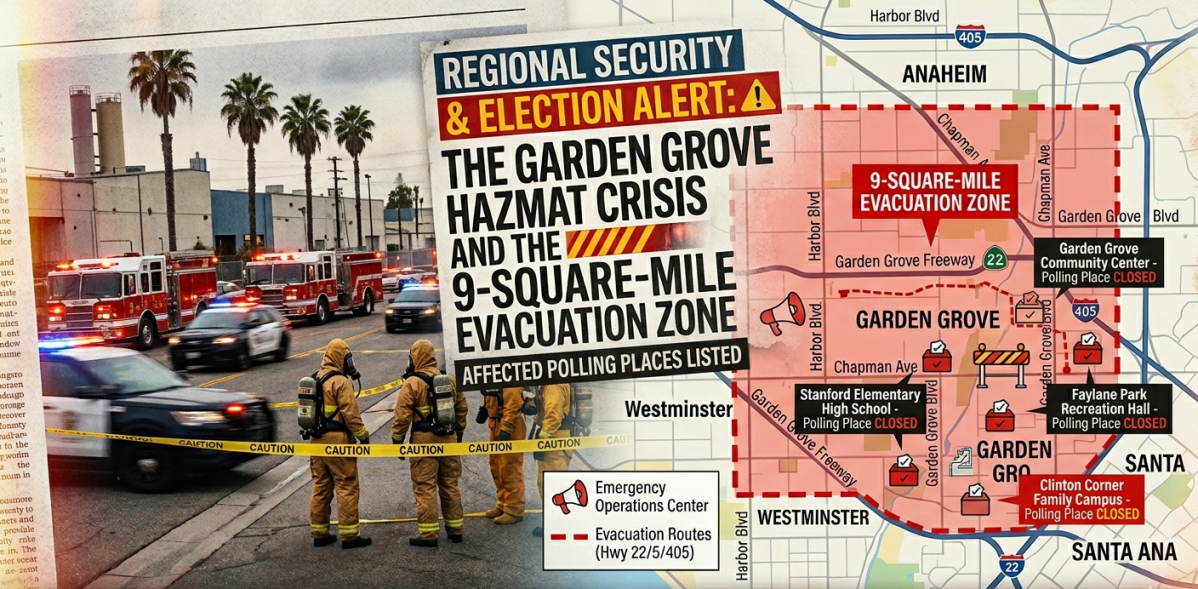
BÀI XÃ LUẬN: Lá phiếu bị nhấn chìm — Khủng hoảng hóa chất tại Garden Grove đang trở thành rào cản bất đối xứng đối với cử tri như thế nào

Các điểm bỏ phiếu bị ảnh hưởng

Thảm họa công nghiệp đang diễn ra tại cơ sở GKN Aerospace trên đường Western Avenue không còn đơn thuần là một cuộc khủng hoảng môi trường và an toàn công cộng. Khi vùng sơ tán bắt buộc phong tỏa chín dặm vuông trên khắp các khu vực Garden Grove, West Anaheim, Cypress, Stanton và Westminster, nó đã biến tướng thành một chướng ngại vật nghiêm trọng, bất đối xứng, cản trước việc tiếp cận hòm phiếu của hàng mươi ngàn cử tri thuộc tầng lớp lao động — với những hệ lụy mang tính cấu trúc gây ảnh hưởng nặng nề nhất đến các cử tri Dân chủ tại địa phương.

Chỉ còn vài ngày nữa là đến cuộc bầu cử sơ bộ, một bồn chứa 34,000 gallon đang bị nứt và biến dạng, tràn ngập hơi hóa chất Methyl Methacrylate dễ bay hơi, đã làm được điều mà các chiêu trò phân chia lại khu vực bầu cử (gerrymandering) hiếm khi thực hiện được: đóng cửa hoàn toàn một trung tâm bỏ phiếu sớm cốt lõi và phong tỏa các thùng phiếu an toàn đằng sau các hàng rào băng cảnh báo vật liệu nguy hiểm.

Vào thứ Bảy, Trung tâm Thể thao và Giải trí Garden Grove trên đường Deodara Drive theo kế hoạch sẽ mở cửa như một điểm bỏ phiếu sớm quan trọng. Thay vào đó, nó đã bị tước bỏ đột ngột chức năng cựu trào này để hạt trưng dụng làm nơi trú ẩn khẩn cấp cho các gia đình đang chạy trốn khỏi luồng khí độc. Đồng thời, ba thùng phiếu an toàn trong khu vực — tại Công viên Thể thao Chapman, Thư viện Nhánh Stanton và Trung tâm Công giáo Các Thánh Tử Đạo Hàn Quốc — đã bị phong tỏa hoàn toàn, khiến công chúng không thể tiếp cận để bầu cử.

Đối với những nhà quan sát khách quan theo dõi bàn cờ chính trị tại trung tâm Quận Cam, sự gián đoạn về mặt địa lý này không hề mang tính trung lập về mặt chính trị. 50,000 cư dân hiện đang phải di tản theo lệnh sơ tán này sinh sống tại những khu vực có mật độ dân cư đông đúc nhất, phần lớn là giới lao động và các phân khu bầu cử vốn nghiêng mạnh về phía Đảng Dân chủ trong khu vực.

Hệ số ma sát: Việc bỏ phiếu đòi hỏi năng lượng tinh thần, thời gian và một địa lý quen thuộc, ổn định. Khi một gia đình bị buộc phải rời khỏi nhà, phải quay cuồng lo liệu nơi ở tạm thời, đối mặt với việc trường học đóng cửa và nguy cơ nhiễm độc hóa chất, việc bỏ phiếu ngay lập tức bị đẩy từ nghĩa vụ cựu trào xuống hàng thứ yếu đầy xa xỉ.

Sự xáo trộn này vô tình tạo ra một rào cản mang tính đảng phái rõ rệt. Theo thống kê, những cử tri sống dưới bóng mát của các hành lang công nghiệp nặng như Western Avenue thường có thu nhập thấp hơn và tỷ lệ thuê nhà cao, những người phụ thuộc rất nhiều vào cơ sở hạ tầng dân sinh ngay tại khu phố — như các thùng phiếu tiện lợi hoặc các trung tâm cộng đồng gần nhà. Các cử tri Dân chủ đã ghi danh tại các phân khu đặc thù này thường dựa vào làn sóng bỏ phiếu sớm trực tiếp hoặc việc thả phiếu vào thùng vào phút chót để củng cố tỷ lệ cử tri đi bầu. Bằng cách đóng cửa trung tâm trên đường Deodara và niêm phong ba thùng phiếu cốt lõi, cuộc khủng hoảng đã tước đi chính cơ sở hạ tầng tiện ích mà cử tri thuộc tầng lớp lao động cần nhất.

Cơ quan Đăng ký Cử tri Quận Cam đã nhanh chóng ứng phó bằng cách chuyển hướng hoạt động sang các địa điểm thay thế như Tòa nhà Cộng đồng Miriam Warne ở Westminster. Nhưng việc yêu cầu một cử tri đang phải di tản, người có thể thiếu phương tiện di chuyển đáng tin cậy, hoặc đang phải chật vật quản lý cuộc khủng hoảng gia đình trong một phòng nhà nghỉ tạm thời, phải di chuyển qua các ranh giới thành phố khác chỉ để bỏ phiếu là một đòi hỏi quá lớn. Mỗi lớp thời gian di chuyển tăng thêm, mỗi tiêu đề báo chí gây hoang mang về các cơ sở bị đóng cửa, và mỗi sự lệch hướng khỏi thói quen sinh hoạt bình thường đều hoạt động như một hình thức áp chế cử tri một cách gián tiếp. Đây là một tác dụng phụ ngoài ý muốn nhưng mang tính cấu trúc từ sự thất bại của cơ sở hạ tầng doanh nghiệp.

Khi bồn chứa hóa chất cuối cùng được làm nguội và tiến trình mổ xẻ chính trị hậu khủng hoảng bắt đầu, ban lãnh đạo Quận Cam phải nhìn nhận lại một cách nghiêm túc về quy hoạch không gian đô thị — nơi đã cho phép một cơ sở hóa chất dễ bay hơi bắt giữ quyền tiếp cận dân chủ của 50,000 công dân làm con tin. Việc một thực thể doanh nghiệp yếu kém trong bảo trì cơ sở không bao giờ được phép đánh thuế lên quyền lợi chính trị của cộng đồng xung quanh.

Trong những ngày áp chót mang tính quyết định trước cuộc bầu cử, các tổ chức cộng đồng và hệ thống đảng bộ địa phương phải nỗ lực gấp đôi để lấp đầy khoảng trống này. Các thùng phiếu có thể đang nằm sau làn ranh hazmat nguy hiểm, nhưng tiếng nói của người dân trung tâm Quận Cam không thể bị bỏ lại phía sau luồng khí độc.

Nguồn lực khẩn cấp cho cử tri bị ảnh hưởng do sơ tán

  • Trung tâm bỏ phiếu sớm thay thế: Tòa nhà Cộng đồng Miriam Warne (Miriam Warne Community Building), số 14491 Beach Boulevard, Westminster. Địa điểm này hiện đang hoạt động toàn diện để phục vụ các cử tri bỏ phiếu trực tiếp và cấp lá phiếu thay thế.
  • Cơ chế bỏ phiếu linh hoạt: Bất kỳ cử tri nào nằm trong diện sơ tán đều có thể đến bất kỳ Trung tâm Bỏ phiếu nào đang hoạt động trên toàn Quận Cam để yêu cầu cấp lá phiếu thay thế an toàn tại chỗ, trong trường hợp lá phiếu gửi qua thư gốc của họ đã bị bỏ lại trong khu vực phong tỏa.
  • Theo dõi trạng thái: Cư dân được khuyến cáo theo dõi sát trang mạng chính thức của Cơ quan Đăng ký Cử tri Quận Cam hoặc liên hệ trực tiếp với đường dây nóng khẩn cấp của hạt để cập nhật danh sách các địa điểm mở cửa và các thùng phiếu thay thế theo thời gian thực.


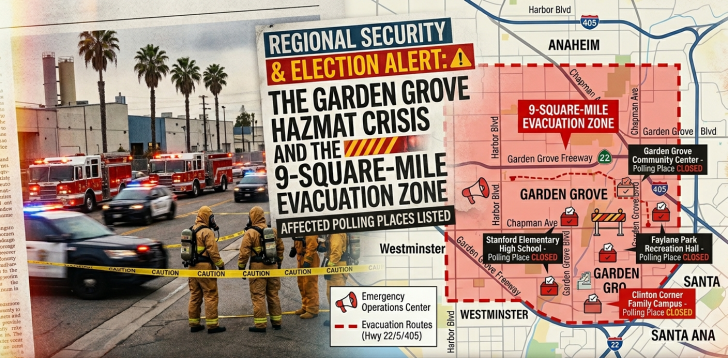
EDITORIAL: El voto sumergido — Cómo la crisis de materiales peligrosos en Garden Grove bloquea el acceso a las urnas

Centros de votación afectados

El desastre industrial que se desarrolla en la instalación de GKN Aerospace en Western Avenue ya no es solo una crisis ambiental y de seguridad pública. A medida que la zona de evacuación obligatoria bloquea nueve millas cuadradas a lo largo de Garden Grove, West Anaheim, Cypress, Stanton y Westminster, se ha convertido en un obstáculo grave y asimétrico para el acceso al voto de decenas de miles de trabajadores, con repercusiones estructurales que afectan con mayor fuerza a los demócratas locales.

A pocos días de las elecciones primarias, un tanque agrietado y deformado de 34,000 galones cargado con vapor volátil de metacrilato de metilo ha logrado lo que la manipulación política tradicional rara vez consigue: el cierre total de un centro clave de votación anticipada y el bloqueo físico de buzones electorales seguros tras cintas de peligro biológico.

El sábado, el Centro Deportivo y Recreativo de Garden Grove en Deodara Drive estaba programado para abrir sus puertas como un destino fundamental para la votación anticipada. En su lugar, fue despojado abruptamente de su función cívica y reutilizado por el condado como refugio de emergencia para las familias que huyen de la columna de humo tóxico. Al mismo tiempo, tres buzones electorales seguros de la región —en Chapman Sports Park, la biblioteca de la sucursal de Stanton y el Centro Católico de los Mártires de Corea— han sido acordonados, quedando completamente inaccesibles para el público votante.

Para el observador objetivo que sigue el panorama político del centro del Condado de Orange, esta interrupción geográfica no es políticamente neutral. Los 50,000 residentes desplazados actualmente por esta orden de evacuación viven en algunos de los distritos electorales más densamente poblados, de clase trabajadora y de fuerte tendencia demócrata en la región.

El factor de fricción: Votar requiere tiempo, claridad mental y una geografía predecible. Cuando una familia es forzada a abandonar su hogar y debe lidiar con la logística de una vivienda temporal, el cierre de escuelas y la posible exposición a sustancias químicas, el voto se desplaza instantáneamente de ser un deber cívico a convertirse en un lujo secundario.

Esta fricción crea un obstáculo partidista evidente. Estadísticamente, los votantes que viven bajo la sombra inmediata de corredores industriales pesados como Western Avenue pertenecen a sectores de menores ingresos y alquileres altos que dependen en gran medida de la infraestructura hiperlocal: buzones de entrega en el vecindario y centros comunitarios cercanos. Los demócratas registrados en estos distritos específicos suelen apoyarse en la votación anticipada en persona o en la entrega de boletas a última hora para consolidar la participación. Al cerrar el centro de Deodara Drive y sellar tres buzones principales, la crisis elimina precisamente la infraestructura de conveniencia que los votantes de la clase trabajadora más necesitan.

El Registro de Votantes del Condado de Orange ha actuado con rapidez para adaptarse, redirigiendo las operaciones a sitios alternativos como el Edificio Comunitario Miriam Warne en Westminster. Sin embargo, pedirle a un votante desplazado que tal vez carezca de transporte confiable, o que actualmente gestiona una crisis familiar en la habitación de un motel temporal, que viaje a otra ciudad para emitir su voto es una exigencia alta. Cada capa de tiempo de viaje adicional, cada titular confuso sobre instalaciones cerradas y cada desvío de la rutina normal actúa como una forma sutil de supresión de votantes. Es un efecto secundario e involuntario de una falla en la infraestructura corporativa.

Cuando el tanque finalmente se enfríe y comience el análisis político posterior, la dirigencia del Condado de Orange deberá examinar de cerca la planificación urbana que permitió que un activo químico volátil tomara como rehén el acceso democrático de 50,000 ciudadanos. El fracaso de una entidad corporativa en el mantenimiento de sus instalaciones nunca debería cobrarle un impuesto a los derechos políticos de la comunidad circundante.

In los días críticos que quedan antes de la elección, las organizaciones comunitarias y la infraestructura del partido local deben trabajar el doble para cerrar esta brecha. Puede que las urnas estén detrás de una línea de materiales peligrosos, pero las voces del centro del Condado de Orange no pueden permitirse quedar atrapadas en la columna de humo.

Recursos de emergencia para votantes desplazados

  • Centro alternativo de votación anticipada: Edificio Comunitario Miriam Warne, 14491 Beach Boulevard, Westminster. Este sitio está completamente operativo para votantes en persona y boletas de reemplazo.
  • Flexibilidad electoral: Cualquier votante evacuado puede acudir a cualquier Centro de Votación operativo en todo el Condado de Orange para solicitar una boleta de reemplazo segura si dejó su boleta original de voto por correo dentro de la zona de evacuación.
  • Seguimiento de la situación: Se insta a los residentes a consultar el sitio web oficial del Registro de Votantes del Condado de Orange o a ponerse en contacto directamente con la línea telefónica de emergencia del condado para verificar la apertura de ubicaciones y buzones alternativos en tiempo real.

EDITORIAL: The Submerged Vote — How the Garden Grove Hazmat Crisis Acts as an Asymmetric Roadblock to the Ballot

Affected Voting Polls

The active industrial disaster at the GKN Aerospace facility on Western Avenue is no longer just an environmental and public safety crisis. As the mandatory evacuation zone locks down nine square miles across Garden Grove, West Anaheim, Cypress, Stanton, and Westminster, it has mutated into a severe, asymmetric obstacle to ballot access for tens of thousands of working-class voters—with structural ripples that hit local Democrats the hardest.

With the primary election just days away, a bulging, cracked 34,000-gallon tank of volatile Methyl Methacrylate vapor has achieved what standard political gerrymandering rarely manages: the outright closure of a primary early-voting hub and the physical barricading of secure ballot drop boxes behind hazardous materials tape.

On Saturday, the Garden Grove Sports and Recreation Center on Deodara Drive was scheduled to open its doors as a critical early-voting destination. Instead, it was abruptly stripped of its civic function, repurposed by the county as an emergency shelter for families fleeing the toxic plume. Concurrently, three regional secure ballot drop boxes—at Chapman Sports Park, the Stanton Branch Library, and the Korean Martyrs Catholic Center—have been cordoned off, rendered completely inaccessible to the voting public.

For the objective observer tracking the political landscape of central Orange County, this geographical disruption is not politically neutral. The 50,000 residents currently displaced by this evacuation order live in some of the most densely populated, working-class, and heavily Democratic-leaning precincts in the region.

The Friction Coefficient: Voting requires mental bandwidth, time, and predictable geography. When a family is forced from their home, navigating the logistics of temporary housing, school closures, and potential chemical exposure, voting is instantly relegated from a civic duty to a secondary luxury.

This friction creates a distinct partisan hurdle. Statistically, the voters living in the immediate shadow of heavy industrial corridors like Western Avenue are lower-income, rent-heavy demographics who rely heavily on hyper-local infrastructure—neighborhood drop boxes and nearby community hubs. Registered Democrats in these specific precincts often rely on high-momentum, in-person early voting or last-minute drop-box drops to solidify turnout. By shuttering the Deodara Drive center and sealing off three core drop boxes, the crisis strips away the exact convenience infrastructure that working-class voters need most.

The Orange County Registrar of Voters has moved swiftly to adapt, redirecting operations to alternative sites like the Miriam Warne Community Building in Westminster. But asking a displaced voter who may lack reliable transportation, or who is currently managing a household crisis in a temporary motel room, to travel across city lines to cast a ballot is a steep ask. Every layer of added travel time, every confusing headline about closed facilities, and every diversion from a normal routine acts as a soft form of voter suppression. It is an unintended, structural side-effect of a corporate infrastructure failure.

When the tank finally cools and the political post-mortem begins, Orange County leadership must look closely at the spatial planning that allowed a volatile chemical asset to hold the democratic access of 50,000 citizens hostage. A corporate entity’s failure to maintain its facility should never extract a tax on the political franchise of the surrounding community.

In the critical days remaining before the election, grassroots organizations and local party infrastructure must work doubly hard to bridge this gap. The ballot boxes may be behind a hazmat line, but the voices of central Orange County cannot afford to be left in the plume.

Displaced Voter Emergency Resources

  • Alternative Early Vote Center: Miriam Warne Community Building, 14491 Beach Boulevard, Westminster. This site is fully operational for walk-ins and replacement ballots.
  • Ballot Flexibility: Any evacuated voter can enter any operational Vote Center across Orange County to request a secure replacement ballot on demand if their original mail-in ballot was left behind in the evacuation zone.
  • Status Tracking: Residents are urged to check the official Orange County Registrar of Voters website or contact the county emergency hotline directly to verify open locations and alternative drop boxes in real-time.

EDITORIAL: El Escudo Y La Placa De Plata: Las Amenazas A La Seguridad Pública Debido A La Confianza Ciega Del SAPD En La Seguridad Privada

SAPD atendiendo una llamada de un guardia de seguridad

La seguridad de todas las personas que viven en Santa Ana se ve amenazada por una presencia emergente y no regulada en las aceras. Este es el dominio donde el personal de seguridad privada —empleado para proteger negocios específicos— descuida sus funciones asignadas e ingresa a las áreas públicas para imponer su propia interpretación de las normas legales.

La preocupación no radica únicamente en que el guardia de seguridad actúe como si fuera un policía; más bien, abarca el hecho de que el Departamento de Policía de Santa Ana (SAPD) respalda constantemente a estos guardias, a menudo sin escudriñar las circunstancias ni cuestionar sus narrativas.

Cuando un guardia de seguridad va más allá de su línea de propiedad para confrontar, acosar o intimidar a miembros de la comunidad, deja de funcionar como protector de la propiedad. En su lugar, se convierte en un peligro significativo y altera la paz de la comunidad. Sin embargo, cuando el SAPD responde a solicitudes dudosas de “asistencia de seguridad”, con frecuencia ve al ciudadano local como el sospechoso mientras considera al guardia como la verdadera víctima.

Este sesgo inherente distorsiona nuestro sistema de justicia. El uniforme de un guardia privado aparentemente tiene más influencia para los oficiales que responden que las declaraciones hechas por un ciudadano que paga impuestos o un periodista independiente.

Aún más alarmante es el incumplimiento de los protocolos esenciales. En muchas situaciones, los oficiales del SAPD no evalúan la legitimidad de las licencias que poseen los guardias de seguridad que inician estas llamadas de emergencia.

Una de las muchas empresas de seguridad en Santa Ana, la cual posiblemente podría representar una amenaza para la seguridad pública debido a la falta de profesionalismo de sus guardias de seguridad.

De acuerdo con la Oficina de Servicios de Seguridad e Investigación (BSIS) de California, todos los guardias deben poseer una Guard Card (tarjeta de guardia) válida y, cuando corresponda, una licencia de armas de fuego. Están obligados a presentar estos documentos a petición. Una vez que un guardia abandona su propiedad asignada para instigar un conflicto en un área pública, está sujeto a las mismas leyes que cualquier individuo y puede estar infringiendo la ley mediante una conducta disruptiva, acoso o detención ilegal.

Por otra parte, un guardia puede violar la ley estatal incluso sin salir de la propiedad privada. El simple hecho de permanecer en terreno privado mientras utiliza un lenguaje agresivo, hace amenazas o lanza objetos hacia los espacios públicos constituye una violación de las regulaciones estatales y de las reglas de la BSIS. La conducta alteradora del orden público se caracteriza simplemente como cualquier comportamiento hostil que se extiende a las áreas públicas.

Al omitir la solicitud y verificación oportuna de las credenciales de la BSIS de un guardia bajo estas circunstancias, los oficiales del SAPD no solo están ignorando procedimientos cruciales, sino que también están permitiendo que personas no calificadas o potencialmente peligrosas determinen los arrestos en nuestras calles.

Como consecuencia, nuestra policía local se convierte en un sistema de apoyo financiado por los contribuyentes para las empresas privadas debido a esta confianza ciega. La presencia invasiva de la policía, que a menudo involucra múltiples vehículos y oficiales, deja a nuestras comunidades sintiéndose desamparadas, ya que apoyan a un guardia que en realidad es el agresor. Esto crea la impresión en la comunidad de que la seguridad privada puede operar sin consecuencias, sabiendo que la policía invariablemente los respaldará.

Es esencial reconocer que los guardias de seguridad privada no poseen autoridad de las fuerzas del orden. Su poder se limita estrictamente a la frontera entre la propiedad privada y las aceras públicas, ya que no son agentes de la ley y carecen de facultades policiales.

El Departamento de Policía de Santa Ana debe dejar de ver a las empresas de seguridad privada como parte de las fuerzas del orden. Los oficiales deben aplicar las leyes de manera imparcial: verificando los permisos, evaluando los límites de la propiedad, responsabilizando al personal de seguridad por cualquier amenaza que presente o cualquier objeto que lance a las áreas públicas, y reconociendo cuándo el guardia es el culpable en lugar de los residentes de Santa Ana con los que interactúa.

INVESTIGACIÓN EN CURSO: AYÚDENOS A GARANTIZAR QUE LA SEGURIDAD PRIVADA RINDA CUENTAS

Invitamos a cualquier persona que tenga inquietudes, experiencias o problemas relacionados con los guardias de seguridad privada en Santa Ana, particularmente en la zona del centro (downtown), a compartir sus testimonios.

The OC Reporter está investigando diligentemente a los guardias de seguridad privada que no cumplen con las regulaciones establecidas por el Código de Profesiones y Negocios de California, las leyes estatales y las normas de la BSIS. Por favor, póngase en contacto con nosotros de inmediato si ha experimentado acoso, ha sido testigo de un abuso de autoridad, o posee fotografías, videos o testimonios que puedan ayudar en esta investigación. Su identidad e información se mantendrán bajo estricta confidencialidad.

EDITORIAL: The Shield and the Silver Badge: How SAPD’s Blind Deference to Private Security Threatens Public Safety

SAPD on a Call from a Security Guard

There is an invisible, unregulated gray area expanding across the sidewalks of Santa Ana, and it poses a direct threat to the constitutional rights of every resident. It is the zone where private security guards—hired to protect specific commercial properties—step off their contracted parcels and into the public square to enforce their own brand of street justice.

But the real crisis isn’t just the rogue guard playing cop. The crisis is that the Santa Ana Police Department consistently acts as their personal muscle, arriving on scene to automatically validate the narrative of the person wearing a uniform, regardless of who actually broke the law.

When a private security guard steps past a property line onto a public sidewalk to engage, harass, or intimidate citizens, they are no longer protecting an asset. They are creating a public issue and a massive liability. Yet, time and again, when SAPD responses are triggered by bogus “security assistance” calls, responding officers routinely treat the guard as the default victim and the citizen as the default suspect.

This automatic bias flips the script of justice on its head. In the eyes of arriving officers, the silver badge of a private contractor carries more weight than the word of a tax-paying resident or an independent journalist.

More concerning still is a systemic failure in basic field procedure: SAPD officers routinely fail to verify the state-issued permits of the guards making these emergency calls.

One of many Security Companies in Santa Ana, Which could possibly create a threat to public safety because of unprofessional security guards.

Under California law, the Bureau of Security and Investigative Services (BSIS) mandates that every guard must carry a valid Guard Card and, if applicable, an exposed firearm permit. They are legally required to present these upon request. When a guard leaves their property line to instigate a confrontation on public property, they are legally acting as an ordinary citizen—potentially committing acts of disturbing the peace, harassment, or unlawful detention.

Furthermore, a guard does not even have to physically step off the parcel to violate state regulations. By simply standing on private property and hurling profanity, launching verbal threats, or throwing physical objects across the property line into the public domain—such as an adjacent sidewalk—they are committing a clear violation of state law and BSIS rules. Aggression that crosses into public space is a breach of the peace, plain and simple.

By failing to immediately demand and verify a guard’s BSIS credentials during these incidents, SAPD officers are not just cutting corners; they are enabling unlicensed, volatile, or under-trained individuals to dictate who gets detained on our streets.

This blind deference transforms our local police department into a taxpayer-funded shield for private corporate interests. When a heavy police presence—often involving multiple patrol vehicles and a dozen officers—arrives to back up a guard who was the actual aggressor, it creates a chilling effect in our neighborhoods. It teaches the public that private security can overreach with impunity because the police will always take their side.

Private security guards are not peace officers. They do not possess a gold shield, they do not have police powers, and their authority stops exactly where the private concrete meets the public sidewalk.

It is time for the Santa Ana Police Department to stop treating private security contractors as an extension of the force. Officers must begin enforcing the law symmetrically: check the permits, look at the property lines, hold guards accountable for the threats and objects they hurl into the public space, and recognize that when a security guard crosses the boundary of professional conduct, the guard is the liability—not the community members they are targeting.

INVESTIGATION UNDERWAY: HELP US HOLD PRIVATE SECURITY ACCOUNTABLE

If you have any complaints, encounters, or concerns regarding private security guards in Santa Ana—specifically within the downtown area—we want to hear from you.

The OC Reporter is actively investigating private security guards who are failing to follow California state laws, BSIS policies, and the regulations set forth by the California Business and Professions Code. If you have been harassed, witnessed jurisdictional overreach, or have photos, video, or statements to share, please reach out to us immediately to help us build this investigation. Your information and anonymity will be protected.