
Editorial: The Architecture of Ignorance, Why Orange County’s Law Enforcement Officers Must Be Held to the Standard of the Law

The relationship between a citizen and the state is a fragile contract based on a single, unyielding condition: the law applies equally to everyone.

When an individual breaks a law, the state demands absolute accountability; the excuse of “I didn’t know” is dismissed outright by courts under the oldest legal doctrine in the book—ignorantia juris non excusat (ignorance of the law excuses no one). Yet, a quiet crisis of legitimacy unfolds across Orange County when that exact standard is flipped. We are increasingly witnessing a system where the very officials paid to enforce the rules—from sworn police officers to municipal code enforcement agents—operate with a stunning lack of precision regarding the laws they are tasked to uphold.

To watch a field officer fabricate a charge, guess at a statute, or hand out an arbitrary citation with the casual justification of “let the District Attorney or the traffic court sort it out” is to watch a system slide from law enforcement into state-sanctioned overreach.

It is a betrayal of public trust that forces a vital question: If the citizen must know the law to survive, how can we tolerate an enforcement apparatus that operates in the dark?

The Illusion of Authority

The title “Law Enforcement Officer” carries immense weight. In the eyes of the public, that badge signifies an expert in the rules of the game. But the institutional reality is far different.

Under current legal precedents, courts have carved out dangerous protections for official ignorance. Landmark rulings, like the Supreme Court’s decision in Heien v. North Carolina, explicitly state that an officer’s “objectively reasonable” mistake of law can still justify an arrest or a stop. In short, the judiciary has legalized a double standard: citizens are expected to have perfect legal knowledge, while enforcement officers are granted a margin of error for their ignorance.

This structural loophole creates a culture of administrative laziness. When a city or county treats enforcement as a volume game—focusing on the number of citations written, vehicles impounded, or arrests made—the nuance of the law is the first thing discarded. Field enforcement becomes mechanical, driven by a desire to control space rather than protect constitutional rights.

When Ignorance Crosses Into Perjury

There is a distinct legal boundary where genuine ignorance ends and criminal misconduct begins. When a local official utilizes their state-granted authority to intentionally twist a statute, misrepresent a fact on a police report, or invent a violation out of thin air, they are no longer making a mistake. They are operating under color of law to deprive an individual of their civil liberties.

A signed police report or an issued citation is not a casual piece of paper; it is an official declaration made under penalty of perjury. Passing the buck to the District Attorney’s office to act as a legal filter does not absolve the officer of the initial unlawful seizure.

  • The Standard of Accountability
    • Citizen: Must have perfect knowledge of the law. No excuses allowed.
    • Enforcement: Allowed “reasonable mistakes” of law, creating a structural double standard.

When local governments allow their agents to use the justice system as a trial-and-error experiment on the lives of everyday citizens, they expose themselves to deep systemic rot—and massive civil liability under federal civil rights laws.

Becoming the Mirror: The Citizen’s Mandate

If the institutions of Orange County—from city councils to county supervisors—refuse to mandate rigorous, continuous legal education for their enforcement personnel, then the burden of accountability inevitably shifts to the community.

We cannot afford to be passive consumers of authority. Forcing a government to respect its own boundaries requires a relentless, calculated response from the governed:

  • Objective Documentation: The camera has become the ultimate equalizer in modern civil rights. Openly and legally recording interactions with municipal officials strips away the institutional bias that historically protected official falsehoods.
  • Radical Transparency: Utilizing the California Public Records Act to drag internal training manuals, policy directives, and misconduct records into the sunlight prevents cities from hiding predatory or unconstitutional enforcement patterns.
  • Institutional Friction: Presenting documented evidence of overreach directly to local oversight boards, city council chambers, and independent journalist platforms turns isolated grievances into unavoidable public record.

The badge does not grant an official the right to write their own laws on the fly. Government power is a leased asset, strictly bounded by the text of the law and the consent of the people. When those who hold the handcuffs refuse to learn the rules, it is the fundamental duty of the public to act as a mirror—reflecting their overreach back onto them until compliance with the law is the only option left.


EDITORIAL: The Shield and the Silver Badge: How SAPD’s Blind Deference to Private Security Threatens Public Safety

SAPD on a Call from a Security Guard

There is an invisible, unregulated gray area expanding across the sidewalks of Santa Ana, and it poses a direct threat to the constitutional rights of every resident. It is the zone where private security guards—hired to protect specific commercial properties—step off their contracted parcels and into the public square to enforce their own brand of street justice.

But the real crisis isn’t just the rogue guard playing cop. The crisis is that the Santa Ana Police Department consistently acts as their personal muscle, arriving on scene to automatically validate the narrative of the person wearing a uniform, regardless of who actually broke the law.

When a private security guard steps past a property line onto a public sidewalk to engage, harass, or intimidate citizens, they are no longer protecting an asset. They are creating a public issue and a massive liability. Yet, time and again, when SAPD responses are triggered by bogus “security assistance” calls, responding officers routinely treat the guard as the default victim and the citizen as the default suspect.

This automatic bias flips the script of justice on its head. In the eyes of arriving officers, the silver badge of a private contractor carries more weight than the word of a tax-paying resident or an independent journalist.

More concerning still is a systemic failure in basic field procedure: SAPD officers routinely fail to verify the state-issued permits of the guards making these emergency calls.

One of many Security Companies in Santa Ana, Which could possibly create a threat to public safety because of unprofessional security guards.

Under California law, the Bureau of Security and Investigative Services (BSIS) mandates that every guard must carry a valid Guard Card and, if applicable, an exposed firearm permit. They are legally required to present these upon request. When a guard leaves their property line to instigate a confrontation on public property, they are legally acting as an ordinary citizen—potentially committing acts of disturbing the peace, harassment, or unlawful detention.

Furthermore, a guard does not even have to physically step off the parcel to violate state regulations. By simply standing on private property and hurling profanity, launching verbal threats, or throwing physical objects across the property line into the public domain—such as an adjacent sidewalk—they are committing a clear violation of state law and BSIS rules. Aggression that crosses into public space is a breach of the peace, plain and simple.

By failing to immediately demand and verify a guard’s BSIS credentials during these incidents, SAPD officers are not just cutting corners; they are enabling unlicensed, volatile, or under-trained individuals to dictate who gets detained on our streets.

This blind deference transforms our local police department into a taxpayer-funded shield for private corporate interests. When a heavy police presence—often involving multiple patrol vehicles and a dozen officers—arrives to back up a guard who was the actual aggressor, it creates a chilling effect in our neighborhoods. It teaches the public that private security can overreach with impunity because the police will always take their side.

Private security guards are not peace officers. They do not possess a gold shield, they do not have police powers, and their authority stops exactly where the private concrete meets the public sidewalk.

It is time for the Santa Ana Police Department to stop treating private security contractors as an extension of the force. Officers must begin enforcing the law symmetrically: check the permits, look at the property lines, hold guards accountable for the threats and objects they hurl into the public space, and recognize that when a security guard crosses the boundary of professional conduct, the guard is the liability—not the community members they are targeting.

INVESTIGATION UNDERWAY: HELP US HOLD PRIVATE SECURITY ACCOUNTABLE

If you have any complaints, encounters, or concerns regarding private security guards in Santa Ana—specifically within the downtown area—we want to hear from you.

The OC Reporter is actively investigating private security guards who are failing to follow California state laws, BSIS policies, and the regulations set forth by the California Business and Professions Code. If you have been harassed, witnessed jurisdictional overreach, or have photos, video, or statements to share, please reach out to us immediately to help us build this investigation. Your information and anonymity will be protected.

The Fault Lines of Belonging: Why the Citizenship Debate Could Fracture Orange County

While the justices in Washington D.C. weigh the technicalities of the 14th Amendment, the view from the streets of Santa Ana, Anaheim, and Westminster is far more personal. In Orange County, citizenship isn’t just a legal status; it is the silent engine of our economy and the glue of our neighborhoods. If the Supreme Court moves to dismantle birthright citizenship, they aren’t just changing a rule—they are pulling the plug on the civic life of our county.

The Nightmare of Retroactive Doubt

The most terrifying aspect of this debate isn’t about who arrives tomorrow; it’s about who has been here for decades. Orange County is home to families three and four generations deep. These are people who have never held a foreign passport, who pay into our tax system, and who have built their lives on the bedrock of a U.S. birth certificate.

If that birthright is revoked or “re-verified” based on the status of one’s parents, we are inviting a bureaucratic catastrophe. Imagine a 45-year-old nurse in Irvine or a grandfather in Fullerton suddenly being told their citizenship is “provisional” until they can produce their deceased parents’ residency papers from 1980. Records vanish, businesses close, and the basic trust that allows a community to function disappears.

An Institutional Heart Attack

The ripple effect would paralyze our local government. Our public institutions are staffed by the very people this ruling would target.

  • Law Enforcement: In the OC Sheriff’s Department and our local police forces, hundreds of officers are the American-born children of immigrants. To question their status is to decimate our front-line public safety. Does a veteran sergeant lose his badge because of his parents’ paperwork?
  • The Bench and the Bar: Our legal system relies on finality. If a judge’s or prosecutor’s citizenship is called into question, every conviction they secured and every ruling they signed becomes a target for litigation. We would see the wheels of justice in Santa Ana grind to a permanent, expensive halt.
  • The Classroom: Our schools would lose teachers and administrators who have spent their lives pouring into the next generation, only to be sidelined by an administrative identity crisis.

The High Cost of Exclusion

Beyond the logistics, there is the human toll. We are talking about turning our neighbors into “stateless” people—men and women who belong nowhere else but here. When you tell a significant portion of your population that their roots are no longer valid, you don’t get a more “secure” county; you get a fractured one. You get a community where people are afraid to report crimes, afraid to start businesses, and afraid to participate in the civic life that makes Orange County a leader in California.

Orange County has always been a place where people come to build something permanent. Whether they arrived four generations ago or were born at OC Global Medical Center last year, their contribution is what keeps us moving forward.

The Supreme Court is currently holding the “delete” key over the lives of thousands of our residents. For the sake of our economy, our safety, and our shared humanity, we must hope they understand that you cannot strengthen a nation by tearing out its heart.

Editorial: The Hollow Map: The Reason the Orange County Streets Were Empty of “No Kings” Demonstrations

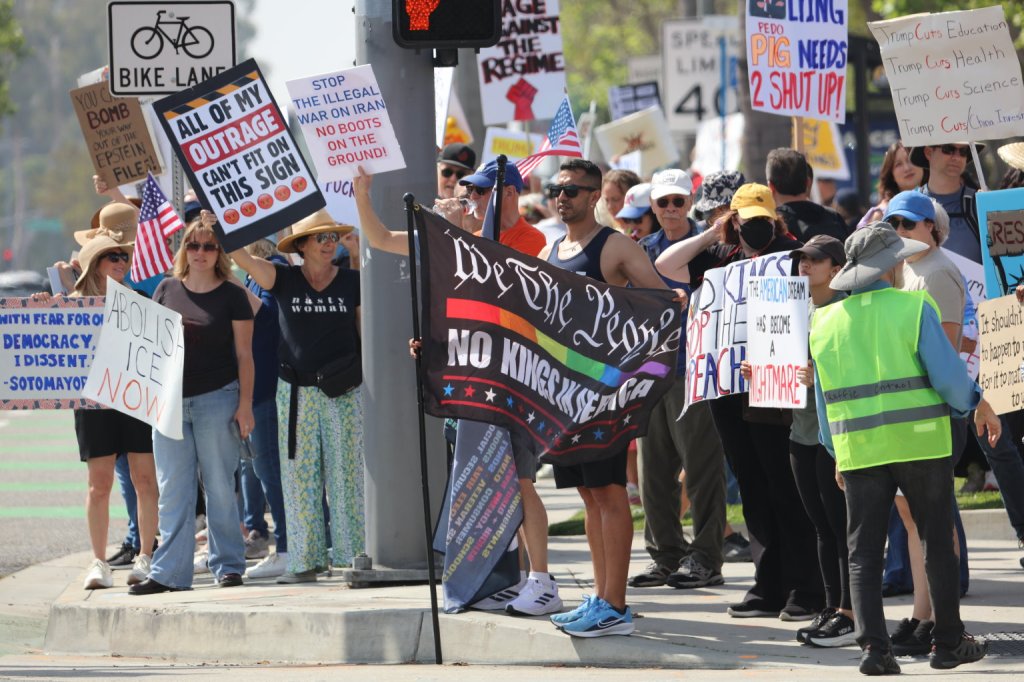
A Peaceful Demonstrator at the No Kings Day Rally – Santa Ana/Costa Mesa

The digital maps for “No Kings Day” portrayed Orange County as a tinderbox of activism on March 28, 2026. Hundreds of pins were dropped from La Habra to San Clemente, signaling a countywide wave of unified demonstrations. However, the reality was quite different from the internet buzz for those who really spent the day walking the streets of OC.

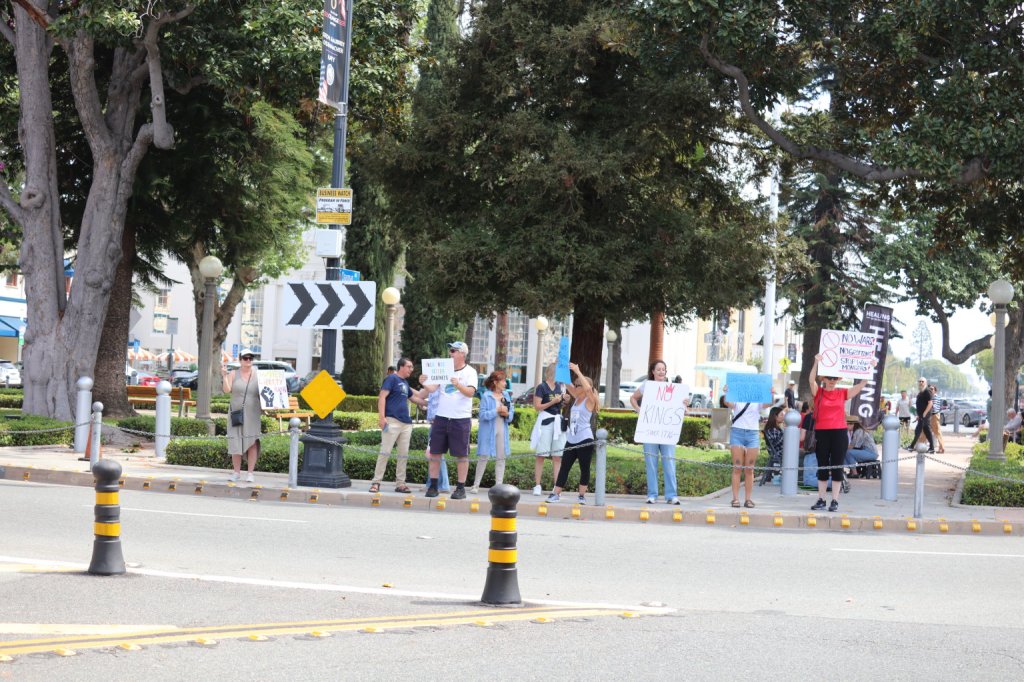
Only eleven individuals were present in the historic Orange Plaza, which is often the site of neighborhood protests. Although there were 300 decent crossings in Santa Ana at the intersection of Bristol and MacArthur, the silence everywhere else was deafening. The “No Kings” campaign failed in Orange County, but not only there; Between its digital aspirations and its physical implementation, it experienced a structural breakdown.

The Failure of the “Micro-Rally”

The event planners chose a “decentralized” approach, fostering local, community-level gatherings. Even though this seems amazing on a website, it is a logistical nightmare to gain momentum. The movement successfully made itself invisible by dispersing a small number of activists throughout 30 separate street corners.

You are a statistical outlier when you have a dozen people at a significant intersection in a county of three million. The “peanut butter approach” distributed resources so widely that the visual effect was diminished.

Micro Rally at The City of Orange Plaza about 11 People Rallied.

The Anaheim Siphon

Additionally, the county’s tranquility can be attributed to the “Flagship” impact. La Palma Park in Anaheim absorbed the majority of the local organizational drive. Thousands of people are said to have congregated there to hear speakers like Ada Briceño, but at the expense of the rest of the county.

The organizers inadvertently implied that the morning “neighborhood rallies” were just optional placeholders by focusing the day on a single late-afternoon event. The average bystander in Orange or Tustin wouldn’t notice the movement since everyone had already begun their journey to Anaheim.

The Reality on the Streets versus Online RSVPs

We are experiencing a period of “Click-tivism,” in which a thousand “Likes” on a Mobilize event page seldom equate to a thousand people in the streets. Many of the “silent” locations that the public saw on March 28th were probably “user-submitted” sites or automatically created incidents that didn’t have a dedicated local captain.

These micro-protests vanished before they could even start because there was no one on the ground to manage the logistics of water, signage, and morale. A map pin represents data, not a community. Data points don’t have indications, as we observed this Saturday.

Santa Ana/ Costa Mesa Rally about 300 people attended

The OC Activism Lesson

“No Kings Day” in Orange County failed to achieve its aim of presenting a united, ubiquitous front. In the majority of our local communities, the movement prioritized accessibility over density and ultimately achieved neither.

The lesson for prospective organizers is straightforward: Without significant, hyper-local infrastructure, a “neighborhood corner” approach would not be effective in Orange County because it is too big and relies too heavily on automobiles. No matter how loudly the internet claims to be, the streets of OC will remain silent unless activists exchange their online pins for real, on-the-ground coordination.