
Editorial: A Call for De-escalation: Rethinking the Fatal Response to Crisis

A Call for De-escalation: Rethinking the Fatal Response to Crisis

The tragic death of a 15-year-old at the hands of the Santa Ana Police Department this past Sunday, June 14, 2026, serves as a harrowing reminder of the lethal consequences that can arise when law enforcement encounters an individual in the midst of a behavioral or mental health crisis. Officers were called to an apartment complex in the 3400 block of Main Street regarding a family disturbance, where they encountered the teenager who was reportedly under the influence and armed with a knife. While the situation involved a reported assault—where the teen allegedly stabbed a 53-year-old man—the outcome, a child dead at the scene, demands a serious re-examination of departmental tactics.

The Failure of Tactical Rigidity

When police respond to calls involving individuals struggling with mental health or substance-induced crises, the goal must be the preservation of life through the calculated application of time, distance, and de-escalation. Instead, the encounter resulted in a fatal shooting, raising critical concerns about the department’s approach:

  • Although officers reportedly gave several commands for the teen to drop the weapon, the transition to lethal force suggests a failure to utilize less-lethal alternatives—such as beanbag rounds or other restraint tools—that could have neutralized the threat without ending a life.
  • In scenarios where an adolescent is visibly erratic or suffering from a mental health episode, the presence of a weapon should trigger a specialized response focused on containment and negotiation rather than a standard tactical confrontation.
  • The department must account for why lethal force was deemed the only viable option against a minor, particularly when standard de-escalation training emphasizes exhausting all other means before resorting to the use of a service weapon.

The Human Cost and Systematic Neglect

Beyond the tactical failures lies a deeper issue: the way our systems treat those in the throes of a breakdown. A teenager in a state of crisis is a person who has lost their way, not a combatant to be eliminated. When we send armed officers to handle what is fundamentally a medical or psychological emergency, we are setting the stage for disaster. The “duty to act” must never supersede the “duty to protect,” especially when the life at stake is that of a child. We have to ask ourselves: when did we decide that the convenience of a swift, lethal resolution is worth more than the potential for a young life to be saved and rehabilitated?

A Demand for Accountability and Reform

The ongoing investigation by the Santa Ana Police Department’s Homicide Unit, Internal Affairs, and the Orange County District Attorney’s Office is a necessary procedural step, but it is not a substitute for systemic change. The community deserves:

  • A full disclosure of the incident details and a rigorous internal audit of the officers’ adherence to use-of-force policies.
  • A shift in policy that mandates the presence of, or consultation with, trained mental health crisis professionals for all domestic disturbances involving signs of behavioral instability.
  • A revision to departmental policy that sets a significantly higher bar for the use of deadly force when the subject is a minor, prioritizing long-term containment over immediate, fatal resolution.

Community Call to Action

The time for silent observation has passed. We urge all concerned residents to attend the upcoming Santa Ana City Council meeting. We must demand that the council place this incident on the agenda for an emergency public hearing. It is imperative that we hold our elected officials and police leadership accountable by voicing our demand for immediate policy reform. Show up, speak out, and ensure that the voices of the community are heard until concrete changes are implemented to prevent such a tragedy from ever happening again.

The loss of a 15-year-old is a profound tragedy that should force the Santa Ana Police Department to confront its own tactical culture. We must move toward a model of public safety where a crisis call results in life-saving intervention rather than a death sentence.


Editorial: The Architecture of Ignorance, Why Orange County’s Law Enforcement Officers Must Be Held to the Standard of the Law

The relationship between a citizen and the state is a fragile contract based on a single, unyielding condition: the law applies equally to everyone.

When an individual breaks a law, the state demands absolute accountability; the excuse of “I didn’t know” is dismissed outright by courts under the oldest legal doctrine in the book—ignorantia juris non excusat (ignorance of the law excuses no one). Yet, a quiet crisis of legitimacy unfolds across Orange County when that exact standard is flipped. We are increasingly witnessing a system where the very officials paid to enforce the rules—from sworn police officers to municipal code enforcement agents—operate with a stunning lack of precision regarding the laws they are tasked to uphold.

To watch a field officer fabricate a charge, guess at a statute, or hand out an arbitrary citation with the casual justification of “let the District Attorney or the traffic court sort it out” is to watch a system slide from law enforcement into state-sanctioned overreach.

It is a betrayal of public trust that forces a vital question: If the citizen must know the law to survive, how can we tolerate an enforcement apparatus that operates in the dark?

The Illusion of Authority

The title “Law Enforcement Officer” carries immense weight. In the eyes of the public, that badge signifies an expert in the rules of the game. But the institutional reality is far different.

Under current legal precedents, courts have carved out dangerous protections for official ignorance. Landmark rulings, like the Supreme Court’s decision in Heien v. North Carolina, explicitly state that an officer’s “objectively reasonable” mistake of law can still justify an arrest or a stop. In short, the judiciary has legalized a double standard: citizens are expected to have perfect legal knowledge, while enforcement officers are granted a margin of error for their ignorance.

This structural loophole creates a culture of administrative laziness. When a city or county treats enforcement as a volume game—focusing on the number of citations written, vehicles impounded, or arrests made—the nuance of the law is the first thing discarded. Field enforcement becomes mechanical, driven by a desire to control space rather than protect constitutional rights.

When Ignorance Crosses Into Perjury

There is a distinct legal boundary where genuine ignorance ends and criminal misconduct begins. When a local official utilizes their state-granted authority to intentionally twist a statute, misrepresent a fact on a police report, or invent a violation out of thin air, they are no longer making a mistake. They are operating under color of law to deprive an individual of their civil liberties.

A signed police report or an issued citation is not a casual piece of paper; it is an official declaration made under penalty of perjury. Passing the buck to the District Attorney’s office to act as a legal filter does not absolve the officer of the initial unlawful seizure.

  • The Standard of Accountability
    • Citizen: Must have perfect knowledge of the law. No excuses allowed.
    • Enforcement: Allowed “reasonable mistakes” of law, creating a structural double standard.

When local governments allow their agents to use the justice system as a trial-and-error experiment on the lives of everyday citizens, they expose themselves to deep systemic rot—and massive civil liability under federal civil rights laws.

Becoming the Mirror: The Citizen’s Mandate

If the institutions of Orange County—from city councils to county supervisors—refuse to mandate rigorous, continuous legal education for their enforcement personnel, then the burden of accountability inevitably shifts to the community.

We cannot afford to be passive consumers of authority. Forcing a government to respect its own boundaries requires a relentless, calculated response from the governed:

  • Objective Documentation: The camera has become the ultimate equalizer in modern civil rights. Openly and legally recording interactions with municipal officials strips away the institutional bias that historically protected official falsehoods.
  • Radical Transparency: Utilizing the California Public Records Act to drag internal training manuals, policy directives, and misconduct records into the sunlight prevents cities from hiding predatory or unconstitutional enforcement patterns.
  • Institutional Friction: Presenting documented evidence of overreach directly to local oversight boards, city council chambers, and independent journalist platforms turns isolated grievances into unavoidable public record.

The badge does not grant an official the right to write their own laws on the fly. Government power is a leased asset, strictly bounded by the text of the law and the consent of the people. When those who hold the handcuffs refuse to learn the rules, it is the fundamental duty of the public to act as a mirror—reflecting their overreach back onto them until compliance with the law is the only option left.

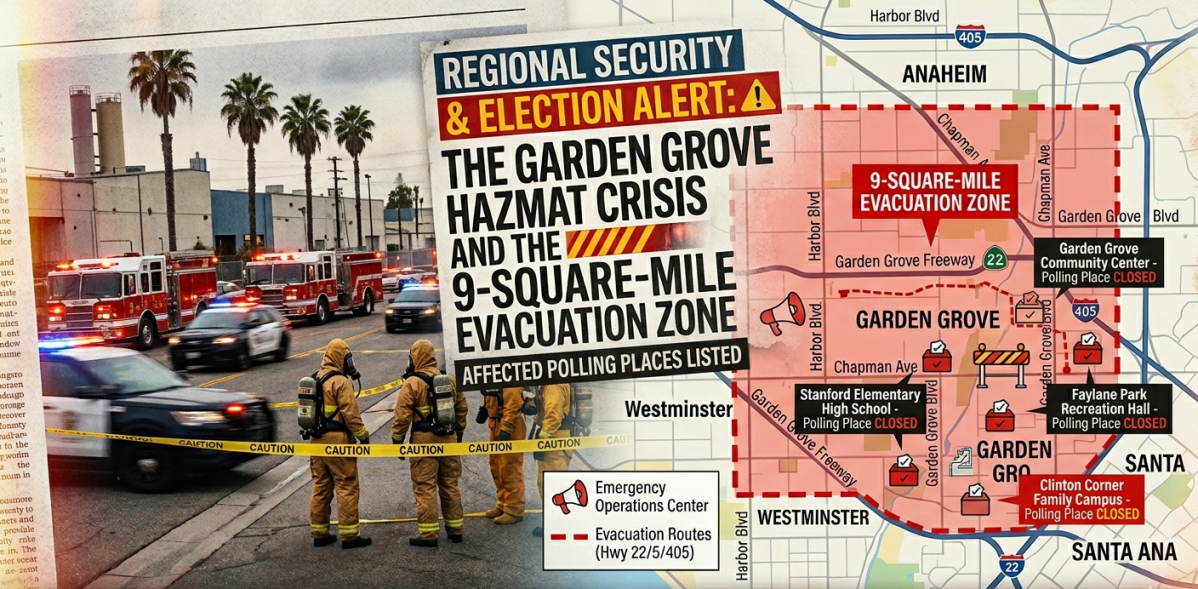
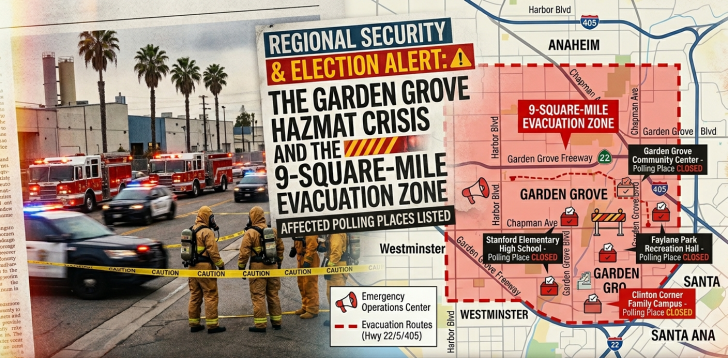
EDITORIAL: The Submerged Vote — How the Garden Grove Hazmat Crisis Acts as an Asymmetric Roadblock to the Ballot

Affected Voting Polls

The active industrial disaster at the GKN Aerospace facility on Western Avenue is no longer just an environmental and public safety crisis. As the mandatory evacuation zone locks down nine square miles across Garden Grove, West Anaheim, Cypress, Stanton, and Westminster, it has mutated into a severe, asymmetric obstacle to ballot access for tens of thousands of working-class voters—with structural ripples that hit local Democrats the hardest.

With the primary election just days away, a bulging, cracked 34,000-gallon tank of volatile Methyl Methacrylate vapor has achieved what standard political gerrymandering rarely manages: the outright closure of a primary early-voting hub and the physical barricading of secure ballot drop boxes behind hazardous materials tape.

On Saturday, the Garden Grove Sports and Recreation Center on Deodara Drive was scheduled to open its doors as a critical early-voting destination. Instead, it was abruptly stripped of its civic function, repurposed by the county as an emergency shelter for families fleeing the toxic plume. Concurrently, three regional secure ballot drop boxes—at Chapman Sports Park, the Stanton Branch Library, and the Korean Martyrs Catholic Center—have been cordoned off, rendered completely inaccessible to the voting public.

For the objective observer tracking the political landscape of central Orange County, this geographical disruption is not politically neutral. The 50,000 residents currently displaced by this evacuation order live in some of the most densely populated, working-class, and heavily Democratic-leaning precincts in the region.

The Friction Coefficient: Voting requires mental bandwidth, time, and predictable geography. When a family is forced from their home, navigating the logistics of temporary housing, school closures, and potential chemical exposure, voting is instantly relegated from a civic duty to a secondary luxury.

This friction creates a distinct partisan hurdle. Statistically, the voters living in the immediate shadow of heavy industrial corridors like Western Avenue are lower-income, rent-heavy demographics who rely heavily on hyper-local infrastructure—neighborhood drop boxes and nearby community hubs. Registered Democrats in these specific precincts often rely on high-momentum, in-person early voting or last-minute drop-box drops to solidify turnout. By shuttering the Deodara Drive center and sealing off three core drop boxes, the crisis strips away the exact convenience infrastructure that working-class voters need most.

The Orange County Registrar of Voters has moved swiftly to adapt, redirecting operations to alternative sites like the Miriam Warne Community Building in Westminster. But asking a displaced voter who may lack reliable transportation, or who is currently managing a household crisis in a temporary motel room, to travel across city lines to cast a ballot is a steep ask. Every layer of added travel time, every confusing headline about closed facilities, and every diversion from a normal routine acts as a soft form of voter suppression. It is an unintended, structural side-effect of a corporate infrastructure failure.

When the tank finally cools and the political post-mortem begins, Orange County leadership must look closely at the spatial planning that allowed a volatile chemical asset to hold the democratic access of 50,000 citizens hostage. A corporate entity’s failure to maintain its facility should never extract a tax on the political franchise of the surrounding community.

In the critical days remaining before the election, grassroots organizations and local party infrastructure must work doubly hard to bridge this gap. The ballot boxes may be behind a hazmat line, but the voices of central Orange County cannot afford to be left in the plume.

Displaced Voter Emergency Resources

  • Alternative Early Vote Center: Miriam Warne Community Building, 14491 Beach Boulevard, Westminster. This site is fully operational for walk-ins and replacement ballots.
  • Ballot Flexibility: Any evacuated voter can enter any operational Vote Center across Orange County to request a secure replacement ballot on demand if their original mail-in ballot was left behind in the evacuation zone.
  • Status Tracking: Residents are urged to check the official Orange County Registrar of Voters website or contact the county emergency hotline directly to verify open locations and alternative drop boxes in real-time.

EDITORIAL: El Escudo Y La Placa De Plata: Las Amenazas A La Seguridad Pública Debido A La Confianza Ciega Del SAPD En La Seguridad Privada

SAPD atendiendo una llamada de un guardia de seguridad

La seguridad de todas las personas que viven en Santa Ana se ve amenazada por una presencia emergente y no regulada en las aceras. Este es el dominio donde el personal de seguridad privada —empleado para proteger negocios específicos— descuida sus funciones asignadas e ingresa a las áreas públicas para imponer su propia interpretación de las normas legales.

La preocupación no radica únicamente en que el guardia de seguridad actúe como si fuera un policía; más bien, abarca el hecho de que el Departamento de Policía de Santa Ana (SAPD) respalda constantemente a estos guardias, a menudo sin escudriñar las circunstancias ni cuestionar sus narrativas.

Cuando un guardia de seguridad va más allá de su línea de propiedad para confrontar, acosar o intimidar a miembros de la comunidad, deja de funcionar como protector de la propiedad. En su lugar, se convierte en un peligro significativo y altera la paz de la comunidad. Sin embargo, cuando el SAPD responde a solicitudes dudosas de “asistencia de seguridad”, con frecuencia ve al ciudadano local como el sospechoso mientras considera al guardia como la verdadera víctima.

Este sesgo inherente distorsiona nuestro sistema de justicia. El uniforme de un guardia privado aparentemente tiene más influencia para los oficiales que responden que las declaraciones hechas por un ciudadano que paga impuestos o un periodista independiente.

Aún más alarmante es el incumplimiento de los protocolos esenciales. En muchas situaciones, los oficiales del SAPD no evalúan la legitimidad de las licencias que poseen los guardias de seguridad que inician estas llamadas de emergencia.

Una de las muchas empresas de seguridad en Santa Ana, la cual posiblemente podría representar una amenaza para la seguridad pública debido a la falta de profesionalismo de sus guardias de seguridad.

De acuerdo con la Oficina de Servicios de Seguridad e Investigación (BSIS) de California, todos los guardias deben poseer una Guard Card (tarjeta de guardia) válida y, cuando corresponda, una licencia de armas de fuego. Están obligados a presentar estos documentos a petición. Una vez que un guardia abandona su propiedad asignada para instigar un conflicto en un área pública, está sujeto a las mismas leyes que cualquier individuo y puede estar infringiendo la ley mediante una conducta disruptiva, acoso o detención ilegal.

Por otra parte, un guardia puede violar la ley estatal incluso sin salir de la propiedad privada. El simple hecho de permanecer en terreno privado mientras utiliza un lenguaje agresivo, hace amenazas o lanza objetos hacia los espacios públicos constituye una violación de las regulaciones estatales y de las reglas de la BSIS. La conducta alteradora del orden público se caracteriza simplemente como cualquier comportamiento hostil que se extiende a las áreas públicas.

Al omitir la solicitud y verificación oportuna de las credenciales de la BSIS de un guardia bajo estas circunstancias, los oficiales del SAPD no solo están ignorando procedimientos cruciales, sino que también están permitiendo que personas no calificadas o potencialmente peligrosas determinen los arrestos en nuestras calles.

Como consecuencia, nuestra policía local se convierte en un sistema de apoyo financiado por los contribuyentes para las empresas privadas debido a esta confianza ciega. La presencia invasiva de la policía, que a menudo involucra múltiples vehículos y oficiales, deja a nuestras comunidades sintiéndose desamparadas, ya que apoyan a un guardia que en realidad es el agresor. Esto crea la impresión en la comunidad de que la seguridad privada puede operar sin consecuencias, sabiendo que la policía invariablemente los respaldará.

Es esencial reconocer que los guardias de seguridad privada no poseen autoridad de las fuerzas del orden. Su poder se limita estrictamente a la frontera entre la propiedad privada y las aceras públicas, ya que no son agentes de la ley y carecen de facultades policiales.

El Departamento de Policía de Santa Ana debe dejar de ver a las empresas de seguridad privada como parte de las fuerzas del orden. Los oficiales deben aplicar las leyes de manera imparcial: verificando los permisos, evaluando los límites de la propiedad, responsabilizando al personal de seguridad por cualquier amenaza que presente o cualquier objeto que lance a las áreas públicas, y reconociendo cuándo el guardia es el culpable en lugar de los residentes de Santa Ana con los que interactúa.

INVESTIGACIÓN EN CURSO: AYÚDENOS A GARANTIZAR QUE LA SEGURIDAD PRIVADA RINDA CUENTAS

Invitamos a cualquier persona que tenga inquietudes, experiencias o problemas relacionados con los guardias de seguridad privada en Santa Ana, particularmente en la zona del centro (downtown), a compartir sus testimonios.

The OC Reporter está investigando diligentemente a los guardias de seguridad privada que no cumplen con las regulaciones establecidas por el Código de Profesiones y Negocios de California, las leyes estatales y las normas de la BSIS. Por favor, póngase en contacto con nosotros de inmediato si ha experimentado acoso, ha sido testigo de un abuso de autoridad, o posee fotografías, videos o testimonios que puedan ayudar en esta investigación. Su identidad e información se mantendrán bajo estricta confidencialidad.

EDITORIAL: The Shield and the Silver Badge: How SAPD’s Blind Deference to Private Security Threatens Public Safety

SAPD on a Call from a Security Guard

There is an invisible, unregulated gray area expanding across the sidewalks of Santa Ana, and it poses a direct threat to the constitutional rights of every resident. It is the zone where private security guards—hired to protect specific commercial properties—step off their contracted parcels and into the public square to enforce their own brand of street justice.

But the real crisis isn’t just the rogue guard playing cop. The crisis is that the Santa Ana Police Department consistently acts as their personal muscle, arriving on scene to automatically validate the narrative of the person wearing a uniform, regardless of who actually broke the law.

When a private security guard steps past a property line onto a public sidewalk to engage, harass, or intimidate citizens, they are no longer protecting an asset. They are creating a public issue and a massive liability. Yet, time and again, when SAPD responses are triggered by bogus “security assistance” calls, responding officers routinely treat the guard as the default victim and the citizen as the default suspect.

This automatic bias flips the script of justice on its head. In the eyes of arriving officers, the silver badge of a private contractor carries more weight than the word of a tax-paying resident or an independent journalist.

More concerning still is a systemic failure in basic field procedure: SAPD officers routinely fail to verify the state-issued permits of the guards making these emergency calls.

One of many Security Companies in Santa Ana, Which could possibly create a threat to public safety because of unprofessional security guards.

Under California law, the Bureau of Security and Investigative Services (BSIS) mandates that every guard must carry a valid Guard Card and, if applicable, an exposed firearm permit. They are legally required to present these upon request. When a guard leaves their property line to instigate a confrontation on public property, they are legally acting as an ordinary citizen—potentially committing acts of disturbing the peace, harassment, or unlawful detention.

Furthermore, a guard does not even have to physically step off the parcel to violate state regulations. By simply standing on private property and hurling profanity, launching verbal threats, or throwing physical objects across the property line into the public domain—such as an adjacent sidewalk—they are committing a clear violation of state law and BSIS rules. Aggression that crosses into public space is a breach of the peace, plain and simple.

By failing to immediately demand and verify a guard’s BSIS credentials during these incidents, SAPD officers are not just cutting corners; they are enabling unlicensed, volatile, or under-trained individuals to dictate who gets detained on our streets.

This blind deference transforms our local police department into a taxpayer-funded shield for private corporate interests. When a heavy police presence—often involving multiple patrol vehicles and a dozen officers—arrives to back up a guard who was the actual aggressor, it creates a chilling effect in our neighborhoods. It teaches the public that private security can overreach with impunity because the police will always take their side.

Private security guards are not peace officers. They do not possess a gold shield, they do not have police powers, and their authority stops exactly where the private concrete meets the public sidewalk.

It is time for the Santa Ana Police Department to stop treating private security contractors as an extension of the force. Officers must begin enforcing the law symmetrically: check the permits, look at the property lines, hold guards accountable for the threats and objects they hurl into the public space, and recognize that when a security guard crosses the boundary of professional conduct, the guard is the liability—not the community members they are targeting.

INVESTIGATION UNDERWAY: HELP US HOLD PRIVATE SECURITY ACCOUNTABLE

If you have any complaints, encounters, or concerns regarding private security guards in Santa Ana—specifically within the downtown area—we want to hear from you.

The OC Reporter is actively investigating private security guards who are failing to follow California state laws, BSIS policies, and the regulations set forth by the California Business and Professions Code. If you have been harassed, witnessed jurisdictional overreach, or have photos, video, or statements to share, please reach out to us immediately to help us build this investigation. Your information and anonymity will be protected.