

Editorial: The Architecture of Ignorance, Why Orange County’s Law Enforcement Officers Must Be Held to the Standard of the Law

The relationship between a citizen and the state is a fragile contract based on a single, unyielding condition: the law applies equally to everyone.

When an individual breaks a law, the state demands absolute accountability; the excuse of “I didn’t know” is dismissed outright by courts under the oldest legal doctrine in the book—ignorantia juris non excusat (ignorance of the law excuses no one). Yet, a quiet crisis of legitimacy unfolds across Orange County when that exact standard is flipped. We are increasingly witnessing a system where the very officials paid to enforce the rules—from sworn police officers to municipal code enforcement agents—operate with a stunning lack of precision regarding the laws they are tasked to uphold.

To watch a field officer fabricate a charge, guess at a statute, or hand out an arbitrary citation with the casual justification of “let the District Attorney or the traffic court sort it out” is to watch a system slide from law enforcement into state-sanctioned overreach.

It is a betrayal of public trust that forces a vital question: If the citizen must know the law to survive, how can we tolerate an enforcement apparatus that operates in the dark?

The Illusion of Authority

The title “Law Enforcement Officer” carries immense weight. In the eyes of the public, that badge signifies an expert in the rules of the game. But the institutional reality is far different.

Under current legal precedents, courts have carved out dangerous protections for official ignorance. Landmark rulings, like the Supreme Court’s decision in Heien v. North Carolina, explicitly state that an officer’s “objectively reasonable” mistake of law can still justify an arrest or a stop. In short, the judiciary has legalized a double standard: citizens are expected to have perfect legal knowledge, while enforcement officers are granted a margin of error for their ignorance.

This structural loophole creates a culture of administrative laziness. When a city or county treats enforcement as a volume game—focusing on the number of citations written, vehicles impounded, or arrests made—the nuance of the law is the first thing discarded. Field enforcement becomes mechanical, driven by a desire to control space rather than protect constitutional rights.

When Ignorance Crosses Into Perjury

There is a distinct legal boundary where genuine ignorance ends and criminal misconduct begins. When a local official utilizes their state-granted authority to intentionally twist a statute, misrepresent a fact on a police report, or invent a violation out of thin air, they are no longer making a mistake. They are operating under color of law to deprive an individual of their civil liberties.

A signed police report or an issued citation is not a casual piece of paper; it is an official declaration made under penalty of perjury. Passing the buck to the District Attorney’s office to act as a legal filter does not absolve the officer of the initial unlawful seizure.

  • The Standard of Accountability
    • Citizen: Must have perfect knowledge of the law. No excuses allowed.
    • Enforcement: Allowed “reasonable mistakes” of law, creating a structural double standard.

When local governments allow their agents to use the justice system as a trial-and-error experiment on the lives of everyday citizens, they expose themselves to deep systemic rot—and massive civil liability under federal civil rights laws.

Becoming the Mirror: The Citizen’s Mandate

If the institutions of Orange County—from city councils to county supervisors—refuse to mandate rigorous, continuous legal education for their enforcement personnel, then the burden of accountability inevitably shifts to the community.

We cannot afford to be passive consumers of authority. Forcing a government to respect its own boundaries requires a relentless, calculated response from the governed:

  • Objective Documentation: The camera has become the ultimate equalizer in modern civil rights. Openly and legally recording interactions with municipal officials strips away the institutional bias that historically protected official falsehoods.
  • Radical Transparency: Utilizing the California Public Records Act to drag internal training manuals, policy directives, and misconduct records into the sunlight prevents cities from hiding predatory or unconstitutional enforcement patterns.
  • Institutional Friction: Presenting documented evidence of overreach directly to local oversight boards, city council chambers, and independent journalist platforms turns isolated grievances into unavoidable public record.

The badge does not grant an official the right to write their own laws on the fly. Government power is a leased asset, strictly bounded by the text of the law and the consent of the people. When those who hold the handcuffs refuse to learn the rules, it is the fundamental duty of the public to act as a mirror—reflecting their overreach back onto them until compliance with the law is the only option left.
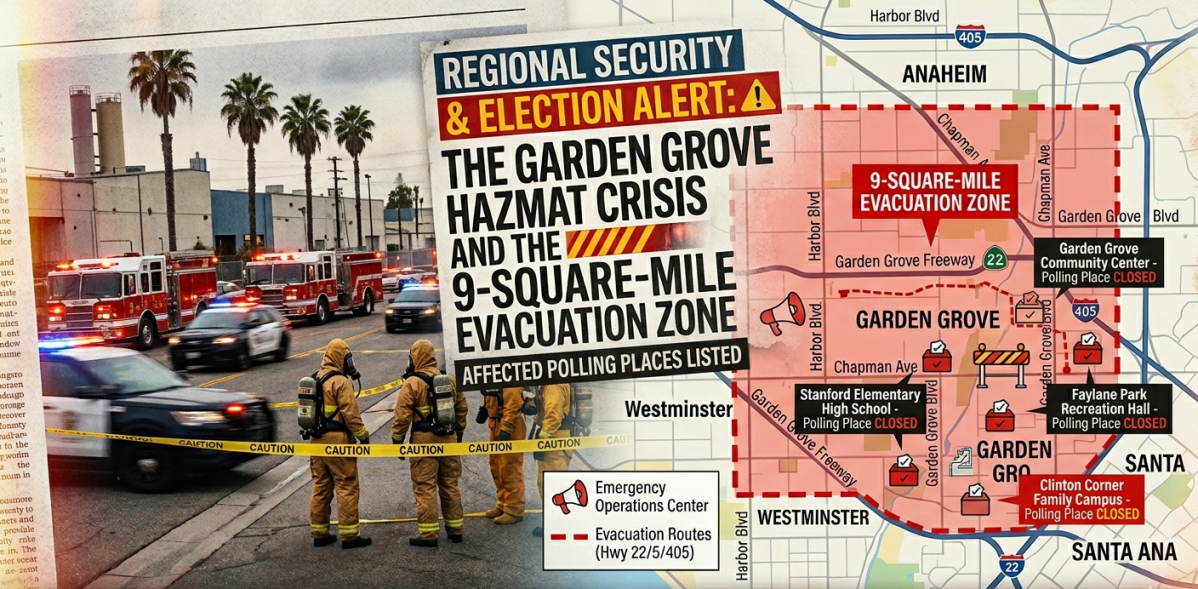
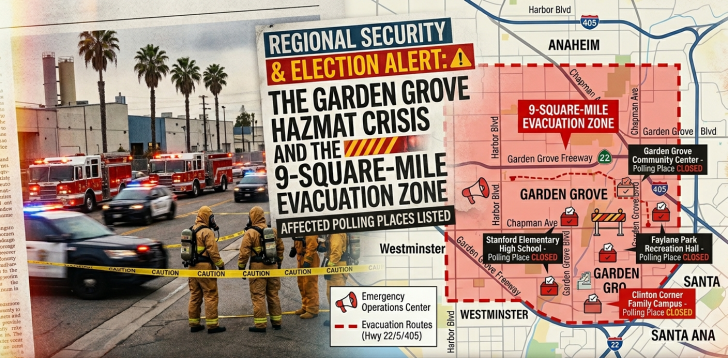
EDITORIAL: The Submerged Vote — How the Garden Grove Hazmat Crisis Acts as an Asymmetric Roadblock to the Ballot

Affected Voting Polls

The active industrial disaster at the GKN Aerospace facility on Western Avenue is no longer just an environmental and public safety crisis. As the mandatory evacuation zone locks down nine square miles across Garden Grove, West Anaheim, Cypress, Stanton, and Westminster, it has mutated into a severe, asymmetric obstacle to ballot access for tens of thousands of working-class voters—with structural ripples that hit local Democrats the hardest.

With the primary election just days away, a bulging, cracked 34,000-gallon tank of volatile Methyl Methacrylate vapor has achieved what standard political gerrymandering rarely manages: the outright closure of a primary early-voting hub and the physical barricading of secure ballot drop boxes behind hazardous materials tape.

On Saturday, the Garden Grove Sports and Recreation Center on Deodara Drive was scheduled to open its doors as a critical early-voting destination. Instead, it was abruptly stripped of its civic function, repurposed by the county as an emergency shelter for families fleeing the toxic plume. Concurrently, three regional secure ballot drop boxes—at Chapman Sports Park, the Stanton Branch Library, and the Korean Martyrs Catholic Center—have been cordoned off, rendered completely inaccessible to the voting public.

For the objective observer tracking the political landscape of central Orange County, this geographical disruption is not politically neutral. The 50,000 residents currently displaced by this evacuation order live in some of the most densely populated, working-class, and heavily Democratic-leaning precincts in the region.

The Friction Coefficient: Voting requires mental bandwidth, time, and predictable geography. When a family is forced from their home, navigating the logistics of temporary housing, school closures, and potential chemical exposure, voting is instantly relegated from a civic duty to a secondary luxury.

This friction creates a distinct partisan hurdle. Statistically, the voters living in the immediate shadow of heavy industrial corridors like Western Avenue are lower-income, rent-heavy demographics who rely heavily on hyper-local infrastructure—neighborhood drop boxes and nearby community hubs. Registered Democrats in these specific precincts often rely on high-momentum, in-person early voting or last-minute drop-box drops to solidify turnout. By shuttering the Deodara Drive center and sealing off three core drop boxes, the crisis strips away the exact convenience infrastructure that working-class voters need most.

The Orange County Registrar of Voters has moved swiftly to adapt, redirecting operations to alternative sites like the Miriam Warne Community Building in Westminster. But asking a displaced voter who may lack reliable transportation, or who is currently managing a household crisis in a temporary motel room, to travel across city lines to cast a ballot is a steep ask. Every layer of added travel time, every confusing headline about closed facilities, and every diversion from a normal routine acts as a soft form of voter suppression. It is an unintended, structural side-effect of a corporate infrastructure failure.

When the tank finally cools and the political post-mortem begins, Orange County leadership must look closely at the spatial planning that allowed a volatile chemical asset to hold the democratic access of 50,000 citizens hostage. A corporate entity’s failure to maintain its facility should never extract a tax on the political franchise of the surrounding community.

In the critical days remaining before the election, grassroots organizations and local party infrastructure must work doubly hard to bridge this gap. The ballot boxes may be behind a hazmat line, but the voices of central Orange County cannot afford to be left in the plume.

Displaced Voter Emergency Resources

  • Alternative Early Vote Center: Miriam Warne Community Building, 14491 Beach Boulevard, Westminster. This site is fully operational for walk-ins and replacement ballots.
  • Ballot Flexibility: Any evacuated voter can enter any operational Vote Center across Orange County to request a secure replacement ballot on demand if their original mail-in ballot was left behind in the evacuation zone.
  • Status Tracking: Residents are urged to check the official Orange County Registrar of Voters website or contact the county emergency hotline directly to verify open locations and alternative drop boxes in real-time.

EDITORIAL: The Shield and the Silver Badge: How SAPD’s Blind Deference to Private Security Threatens Public Safety

SAPD on a Call from a Security Guard

There is an invisible, unregulated gray area expanding across the sidewalks of Santa Ana, and it poses a direct threat to the constitutional rights of every resident. It is the zone where private security guards—hired to protect specific commercial properties—step off their contracted parcels and into the public square to enforce their own brand of street justice.

But the real crisis isn’t just the rogue guard playing cop. The crisis is that the Santa Ana Police Department consistently acts as their personal muscle, arriving on scene to automatically validate the narrative of the person wearing a uniform, regardless of who actually broke the law.

When a private security guard steps past a property line onto a public sidewalk to engage, harass, or intimidate citizens, they are no longer protecting an asset. They are creating a public issue and a massive liability. Yet, time and again, when SAPD responses are triggered by bogus “security assistance” calls, responding officers routinely treat the guard as the default victim and the citizen as the default suspect.

This automatic bias flips the script of justice on its head. In the eyes of arriving officers, the silver badge of a private contractor carries more weight than the word of a tax-paying resident or an independent journalist.

More concerning still is a systemic failure in basic field procedure: SAPD officers routinely fail to verify the state-issued permits of the guards making these emergency calls.

One of many Security Companies in Santa Ana, Which could possibly create a threat to public safety because of unprofessional security guards.

Under California law, the Bureau of Security and Investigative Services (BSIS) mandates that every guard must carry a valid Guard Card and, if applicable, an exposed firearm permit. They are legally required to present these upon request. When a guard leaves their property line to instigate a confrontation on public property, they are legally acting as an ordinary citizen—potentially committing acts of disturbing the peace, harassment, or unlawful detention.

Furthermore, a guard does not even have to physically step off the parcel to violate state regulations. By simply standing on private property and hurling profanity, launching verbal threats, or throwing physical objects across the property line into the public domain—such as an adjacent sidewalk—they are committing a clear violation of state law and BSIS rules. Aggression that crosses into public space is a breach of the peace, plain and simple.

By failing to immediately demand and verify a guard’s BSIS credentials during these incidents, SAPD officers are not just cutting corners; they are enabling unlicensed, volatile, or under-trained individuals to dictate who gets detained on our streets.

This blind deference transforms our local police department into a taxpayer-funded shield for private corporate interests. When a heavy police presence—often involving multiple patrol vehicles and a dozen officers—arrives to back up a guard who was the actual aggressor, it creates a chilling effect in our neighborhoods. It teaches the public that private security can overreach with impunity because the police will always take their side.

Private security guards are not peace officers. They do not possess a gold shield, they do not have police powers, and their authority stops exactly where the private concrete meets the public sidewalk.

It is time for the Santa Ana Police Department to stop treating private security contractors as an extension of the force. Officers must begin enforcing the law symmetrically: check the permits, look at the property lines, hold guards accountable for the threats and objects they hurl into the public space, and recognize that when a security guard crosses the boundary of professional conduct, the guard is the liability—not the community members they are targeting.

INVESTIGATION UNDERWAY: HELP US HOLD PRIVATE SECURITY ACCOUNTABLE

If you have any complaints, encounters, or concerns regarding private security guards in Santa Ana—specifically within the downtown area—we want to hear from you.

The OC Reporter is actively investigating private security guards who are failing to follow California state laws, BSIS policies, and the regulations set forth by the California Business and Professions Code. If you have been harassed, witnessed jurisdictional overreach, or have photos, video, or statements to share, please reach out to us immediately to help us build this investigation. Your information and anonymity will be protected.

Editorial: The Fractures Behind the Glass

Old Clock Tower at 4th and Sycamore

The clock at 4th and Sycamore stands as a silent sentinel over downtown Santa Ana, its hands frozen in a permanent state of arrested development. Most residents pass it without a second glance, but a closer look—the kind of look afforded only by those willing to document the uncomfortable—reveals deep, radiating cracks in its frosted glass. These are not just signs of age; they are a metaphor for a municipal structure that is crumbling while those at the top look the other way.

Nowhere are these fractures more evident than in the administration of Mayor Valeria Amezcua.

A Failure of Leadership

For a city as vibrant and complex as Santa Ana, leadership requires more than just holding a gavel; it requires the courage to address the structural decay within City Hall. Yet, under Mayor Amezcua’s tenure, the “cracks” have only deepened. The administration has become increasingly defined by its alignment with the Santa Ana Police Officers Association (SAPOA), creating a feedback loop that prioritizes special interests over the needs of the everyday people who walk these streets.

The Institutional Chain

The decay follows a clear path from the street level to the highest office:

  • The SAPOA Influence: The political weight of the police union continues to exert an outsized influence on city policy, often at the expense of genuine police accountability.
  • The Police Department: Structural issues within the department remain unaddressed, shielded by a lack of transparent oversight from the council.
  • The Council and Mayor: At the top of this chain sits a Mayor and a City Council that seem content to let the mechanism of government remain broken, provided the facade remains intact.

Documenting the Truth

Just as a photographer captures the “Architecture of Silence”—the metaphysical and structural transitions that others ignore—we must capture the reality of our local government. The cracks in the clock at 4th and Sycamore are bothersome because they represent a choice: the choice to ignore history and allow the foundation of our city to erode.

Mayor Amezcua has failed to be the leader who picks up the tools to fix these breaks. Instead, she presides over a system where transparency is sacrificed for political convenience. As independent oversight and public records requests continue to peel back the layers of municipal citation procedures and data privacy issues, the public is starting to see what has been hidden in plain sight.

It is time to stop walking past the decay. If the government refuses to fix the cracks, it falls upon the people to document them until they can no longer be ignored.

Editorial: The 1972 Collision

The narrative of the 2014 Civic Center bicycle case is no longer just a local story of one man versus a ticket; it has become a case study in how grassroots pressure can predict—and eventually force—statewide reform.

When I took my seat in Department C46 of the Central Justice Center in July 2014, I wasn’t just defending a $400 citation. I was exposing a structural flaw in Orange County’s “bottom-up” policing. Here is an editorial perspective on that journey from the Civic Center to the State Capitol.

By Igmar Rodas – Editor in Chief at The OC Reporter

Circa 2014 – Bicycle used to make the Bicycle Registration City Ordinance from 1972, Obsolete in July 2014.

The Ghost in the Machine

For forty-two years, a ghost lived in the Santa Ana municipal code. Enacted in 1972, the mandatory bicycle registration ordinance was a “silent” law. It wasn’t designed for safety or theft prevention—it was designed as a tool for contact. It sat in the books, largely unknown to the 330,000 residents of the city, until it was needed to justify a stop in the Civic Center.

In 2014, that ghost met a man born the same year the law was written.

The Set-Up and the “Scapegoat”

The battle wasn’t an accident; it was an extraction. After months of documenting the harassment of the homeless and poor—who were often cited for the “crime” of riding an unlicensed bike—the lines were drawn. When I told the officers I was going to buy a bike and dared them to cite me, I was forcing the system to reveal its hand.

When the citation finally came, the irony of the “Architecture of Silence” was on full display. In court, Officer S. Lopez was the one left to defend the indefensible. By turning that bicycle upside down without consent, the department didn’t just find a missing sticker; they found a Fourth Amendment violation. Judge James Crandall’s ruling was the first crack in a wall that had stood for decades.

From Santa Ana to the State Capitol

At the time, our victory felt local. We forced the Santa Ana City Council to admit the law was “idiotic” and repeal it within weeks. But look at where we are now.

In 2022, the State of California finally caught up to what we proved in a Santa Ana courtroom eight years earlier. Assembly Bill 1909 (The Bicycle Omnibus Bill) finally prohibited any city in the state from requiring bicycle registration. The state legislature eventually realized what we already knew: these laws were rarely about bikes and almost always about the “selective harassment” of people law enforcement deemed “undesirable.”

The Long Game of the “Watcher”

To the younger activists today who want rapid results: remember the 1972 ordinance. It took 42 years to build that wall, 8 years for the state to follow our lead, and one man on a bicycle to prove it was hollow.

When we say “start from the bottom,” this is what we mean. You don’t always need to change the Mayor to change the city. Sometimes, you just need to flip the bike over and show the world that the foundation is made of sand.

Key Comparisons: Then vs. Now

EraThe 1972 Ordinance (2014)The AB 1909 Reality (2026)
StatusMandatory & PunitiveStrictly Prohibited
EnforcementUsed for “selective stops”Local licensing bans are statewide
Legal StandingUnlawful Search (Judge Crandall)Protected State Right
The “Bottom”Officers used it as a “hook”One less tool for profiling

“Once the bottom is out, the rest will crumble under its own weight.”

This editorial isn’t just about a bicycle; it’s about the fact that if you hold the mirror up long enough, eventually the state has no choice but to look.